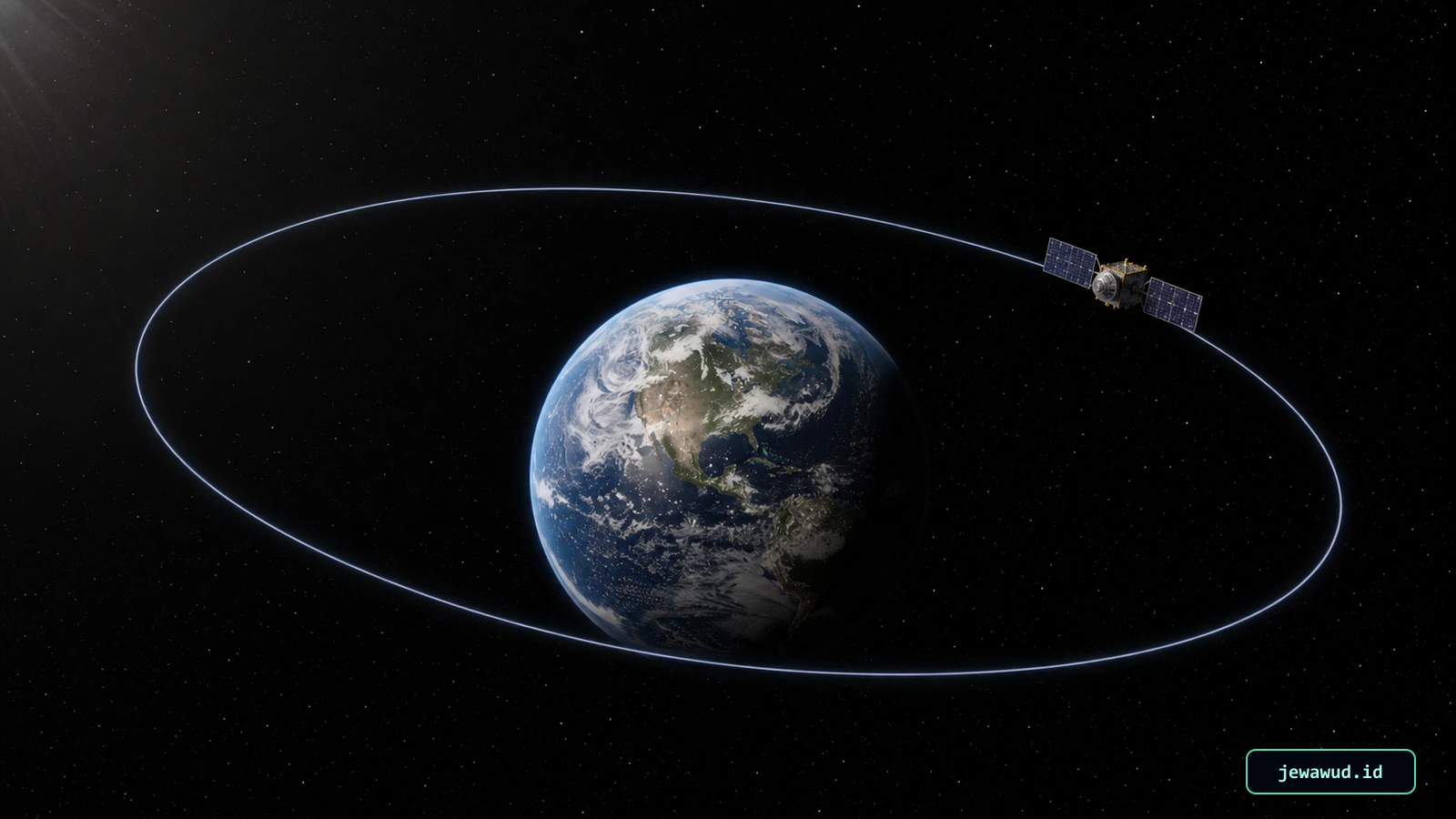
 Orbital period measures one complete revolution; the reference frame and central body must always be stated
01What Orbital Period Actually Means
Orbital period is the time required for an object to complete one revolution around a central body. For an Earth satellite, that central body is Earth. For the Moon, it is also Earth. For Earth itself, the central body is the Sun. The same idea applies in every case, but the numerical period changes with the size of the orbit and the gravitational parameter of the central body.
The word complete matters. A spacecraft may pass over the same latitude, cross the equator, or become visible from a ground station more than once during a revolution. None of those events alone defines the orbital period. The clean Keplerian definition follows the spacecraft through 360 degrees around the orbit relative to inertial space.
The reference frame also matters. A satellite can complete one orbit relative to the stars while Earth rotates beneath it. As a result, its next ground track is usually shifted in longitude. A ground observer therefore should not assume that orbital period, time between visible passes, and time between repeated ground tracks are the same quantity.
02Why An Orbit Has A Clock
A satellite in orbit is continuously falling toward Earth, but it also has enough sideways velocity to keep missing the surface. Gravity supplies the inward acceleration that bends the trajectory. Velocity carries the satellite forward. Together they produce a curved path rather than a straight line or a vertical fall.
For a circular orbit, gravity and the required centripetal acceleration can be equated. This gives the circular orbital speed v = sqrt(μ / r), where r is distance from Earth's center and μ is Earth's gravitational parameter. As radius increases, circular-orbit speed decreases. The satellite also has a larger circumference to travel. A higher orbit therefore combines a longer route with a lower speed, making its period substantially longer.
This is why altitude cannot be considered by itself. The equation uses distance from Earth's center, not distance above the surface. For an approximately circular Earth orbit, use r = RE + h, where RE is the selected Earth radius and h is altitude. Substituting altitude directly for r produces a physically incorrect result.
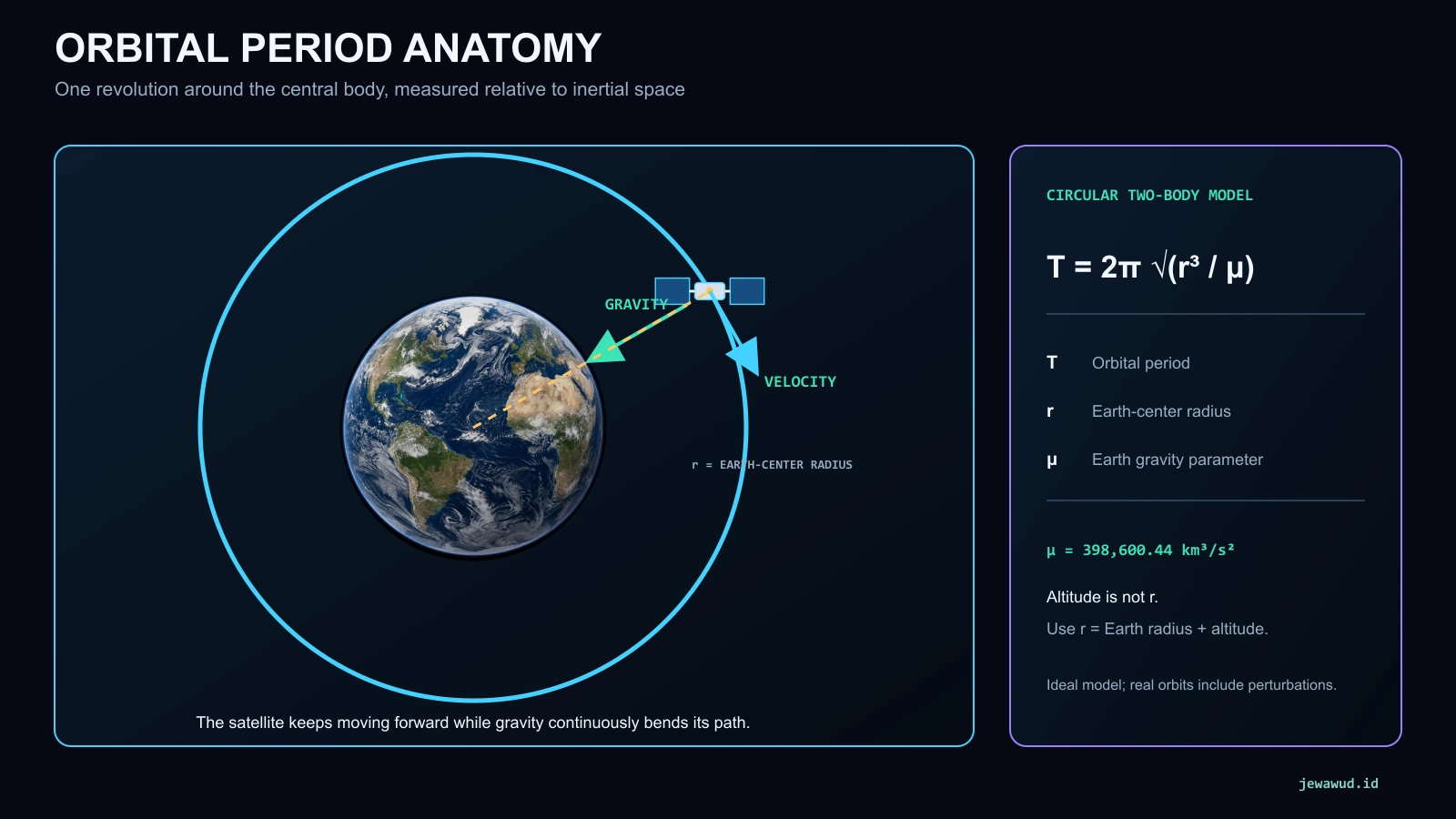 In the ideal circular model, period follows from Earth-center radius and Earth's gravitational parameter
03Kepler's Third Law For Earth Satellites
For a satellite whose mass is negligible compared with Earth, Newton's form of Kepler's third law can be written as T = 2π sqrt(a3 / μ). Here T is orbital period, a is semi-major axis, and μ is the gravitational parameter of the central body. For a circular orbit, semi-major axis and orbital radius are the same, so a = r.
The equation exposes the key scaling law: T is proportional to a3/2. Period does not grow linearly with orbit size. If semi-major axis doubles around the same central body, the period becomes 23/2, or about 2.83 times as long. A satellite moved to a radius four times larger would need eight times the period.
For the representative calculations below, the diagrams use an Earth gravitational parameter of approximately 398,600.44 km3/s2 and an equatorial radius of about 6,378.137 km. These values are suitable for illustrating the ideal two-body relationship. Operational orbit determination uses defined constants, time systems, reference frames, and perturbation models appropriate to the mission.
04From 400 Kilometers To GEO
Consider a circular orbit 400 km above Earth's equator. Adding Earth's equatorial radius gives an orbital radius of about 6,778 km. The two-body equation returns approximately 5,554 seconds, or 92.6 minutes. Real spacecraft near 400 km experience drag, altitude variation, Earth oblateness, and other perturbations, so a live period will vary rather than remain fixed at this rounded example.
GPS satellites operate near 20,200 km altitude in medium Earth orbit. With a radius near 26,578 km, the ideal calculation gives about 11 hours 58 minutes. That is why a GPS satellite circles Earth approximately twice per sidereal day. Multiple orbital planes and multiple satellites provide global geometry; one satellite by itself would not provide continuous worldwide navigation coverage.
At approximately 35,786 km altitude, a circular orbit has a radius near 42,164 km and a period close to 23 hours 56 minutes 4 seconds, one sidereal day. A satellite is geosynchronous when its period matches Earth's sidereal rotation. It becomes geostationary only when the orbit is also circular, equatorial, and prograde, allowing the spacecraft to remain near one longitude in the rotating Earth-fixed view.
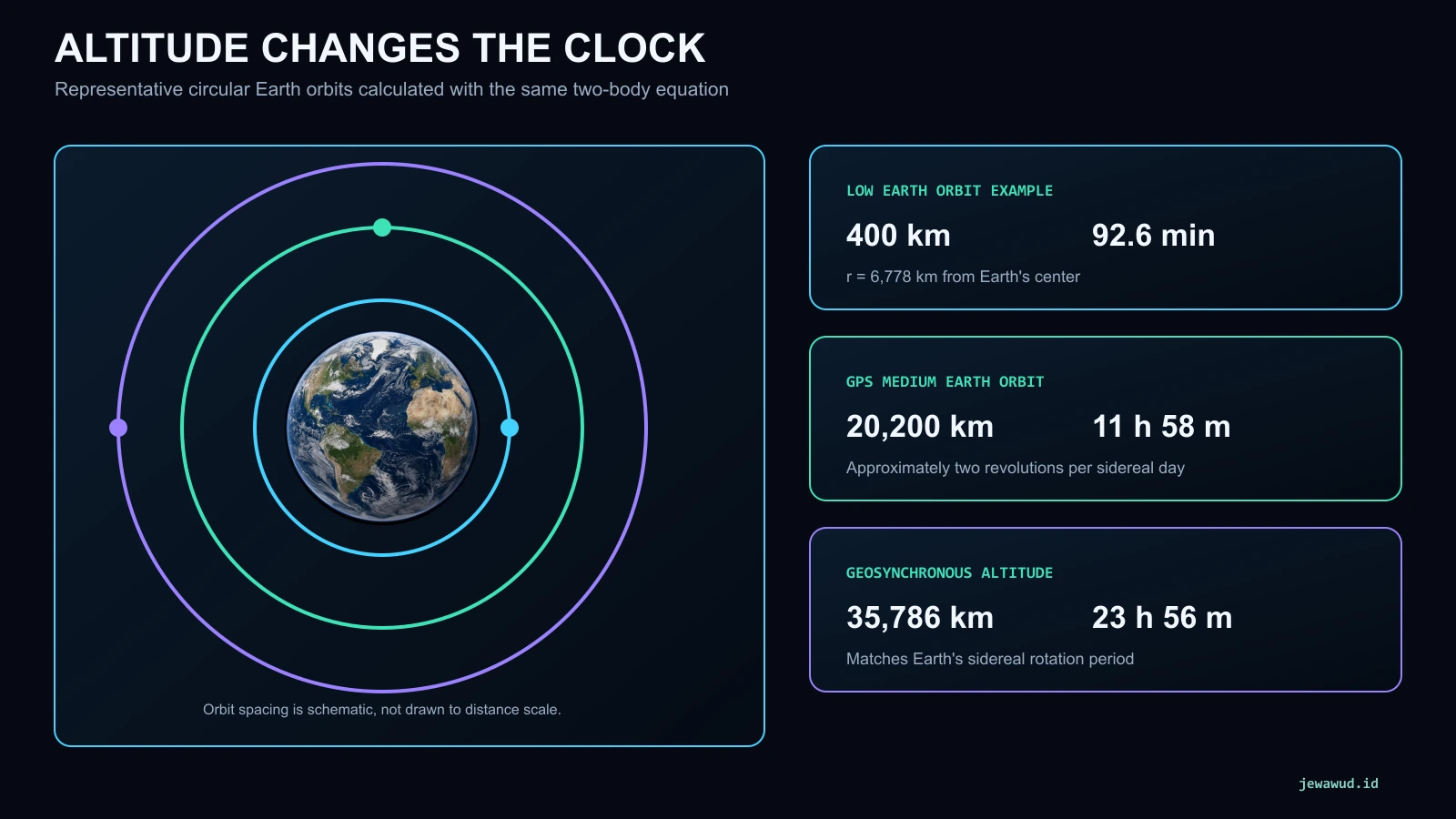 Representative ideal circular periods show how rapidly the orbital clock lengthens with Earth-center radius
05Why Doubling Altitude Does Not Double Period
A common shortcut is to imagine that twice the altitude should mean twice the period. There are two problems with that idea. First, the equation uses semi-major axis from Earth's center rather than altitude from the surface. Second, the three-halves power makes the relationship nonlinear.
Suppose two ideal circular orbits around the same body have semi-major axes a and 2a. Their period ratio is (2a/a)3/2 = 23/2 = 2.828. The larger orbit is twice the radius but takes almost 2.83 times as long. Its circumference is twice as large, while its circular speed is only 1/sqrt(2), or about 70.7 percent, of the inner orbit's speed.
This scaling explains why the difference between LEO and GEO is so dramatic. GEO is not simply a higher version of LEO with a proportionally longer lap. Its center-to-center radius is more than six times that of a 400 km orbit, and its period is more than fifteen times longer.
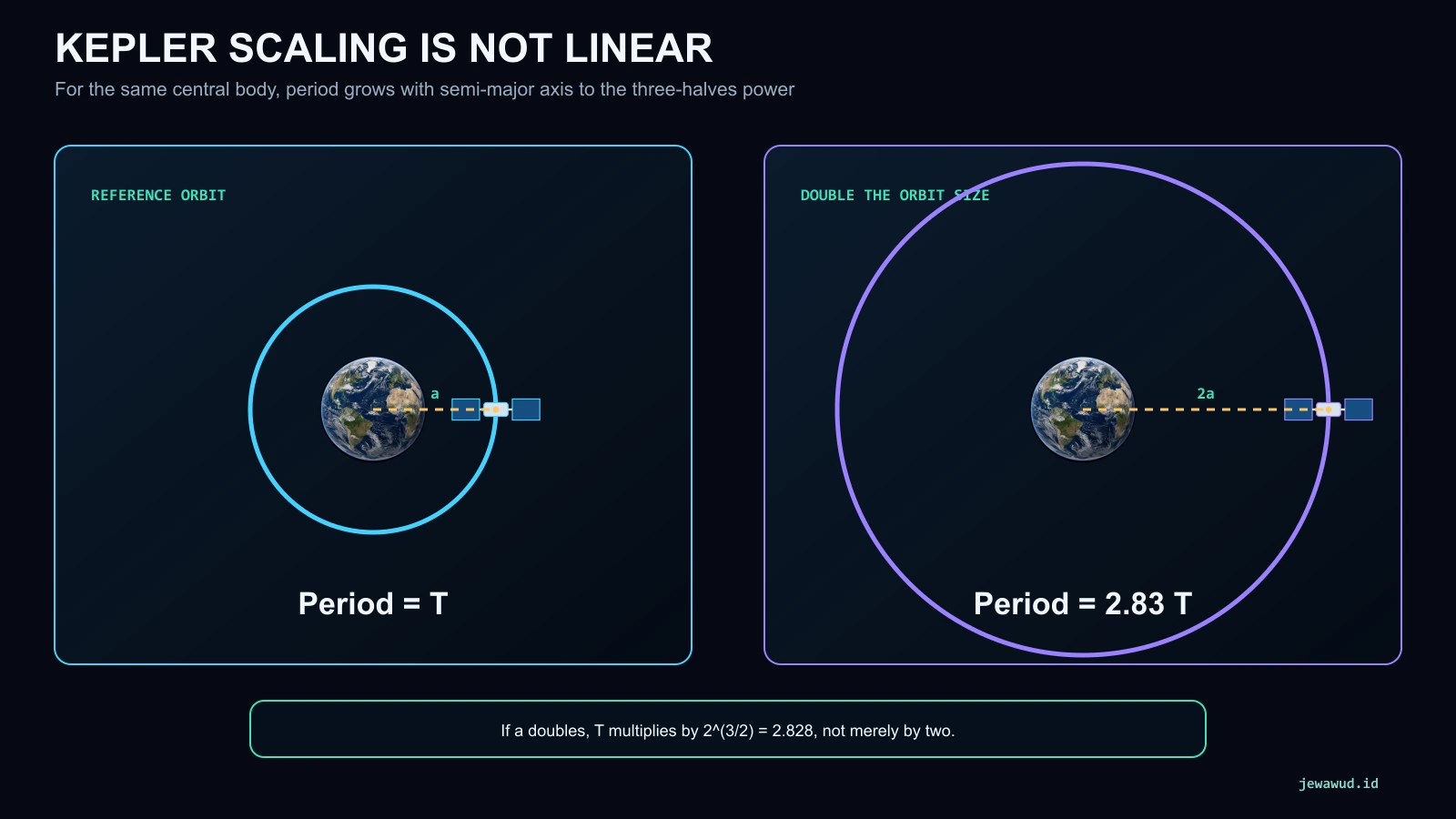 Kepler's third law combines the longer path and lower orbital speed into a three-halves-power relationship
06Elliptical Orbits Use Semi-Major Axis
Altitude changes continuously in an elliptical orbit, so no single instantaneous radius can define the complete period. The relevant size parameter is the semi-major axis, one half of the ellipse's longest diameter. Earth lies at one focus of the ellipse rather than at its geometric center.
In an ideal two-body model, two bound orbits around the same central body have the same period when they have the same semi-major axis, even if one is circular and the other is elliptical. Their speed histories differ. The elliptical-orbit satellite moves faster near perigee and slower near apogee, following Kepler's second law, but the time for the complete revolution remains set by the shared semi-major axis.
For an Earth orbit described by perigee and apogee radii, the semi-major axis is a = (rp + ra) / 2. If the available values are altitudes, add the selected Earth radius to both before averaging. The companion article Perigee and Apogee Explained covers the speed change and ellipse geometry in more detail.
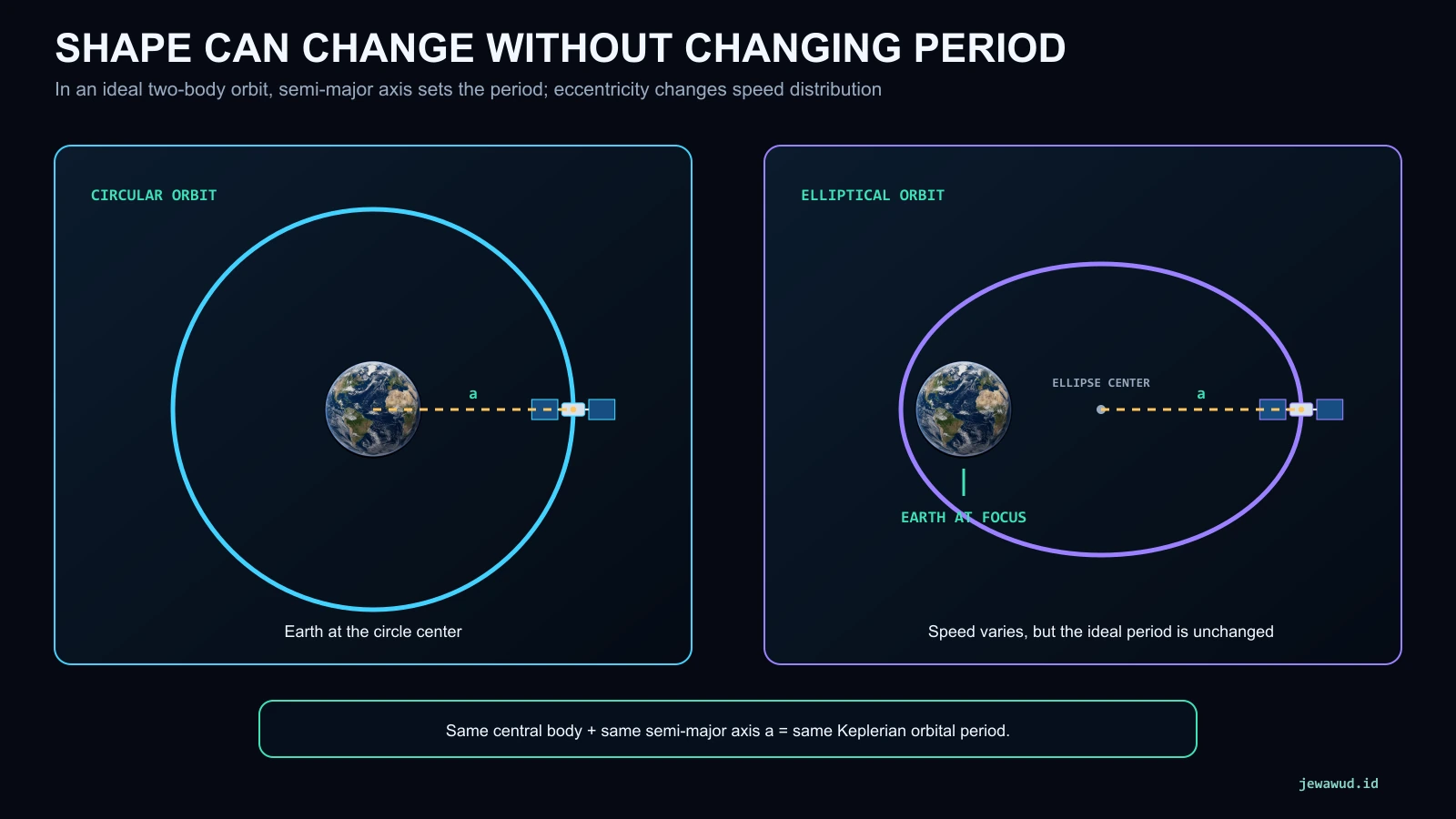 Eccentricity redistributes speed around the path; semi-major axis controls the ideal two-body period
07Period Is Not A Repeat Ground Track
During one satellite revolution, Earth rotates eastward beneath the orbital plane. A 92.6-minute LEO period corresponds to roughly 23 degrees of Earth rotation, using the sidereal rotation rate as a simple estimate. The next ascending-node crossing therefore occurs over a different longitude unless the orbit and Earth rotation form a designed repeat-cycle relationship.
Inclination also changes where the ground track reaches north and south, but it does not enter the ideal period equation. Two circular orbits can have the same radius and period while one is equatorial and the other polar. Their maps look completely different even though their orbital clocks are nearly identical.
A visible pass adds another layer. The observer must be on the rotating Earth, the spacecraft must rise above the local horizon, and lighting conditions may matter for optical visibility. Time between passes can therefore be much longer than one orbit. See Satellite Ground Tracks Explained and Orbital Inclination Explained for those geometric effects.
08Why A Live Tracker's Period Can Drift
Kepler's equation is a powerful first model, not a promise that every observed orbit remains a perfect ellipse forever. Earth's equatorial bulge changes orbital orientation. Atmospheric drag removes energy from low satellites. The Moon and Sun add third-body perturbations. Solar radiation pressure, maneuvers, attitude changes, and mass distribution can also matter.
For TLE-based tracking, mean motion is published in revolutions per day and is related to a mean orbital period. SGP4 propagates the associated mean elements using its own defined model. A period shown by a tracker may therefore be derived from mean motion or from a propagated state rather than from one instantaneous altitude measurement.
Small differences are expected when comparing a rounded altitude example, osculating orbital elements, TLE mean elements, and live telemetry. The correct response is to identify the data source, epoch, model, and reference frame instead of forcing every number to match a simplified classroom calculation.
09References And Further Reading
NASA Science: Orbits and Kepler's Laws explains elliptical orbits, equal areas, and the period-semi-major-axis relationship.
NASA Basics of Space Flight: Gravity and Mechanics connects centripetal acceleration with gravity and summarizes Kepler's laws.
JPL Solar System Dynamics: Astrodynamic Parameters provides adopted gravitational parameters used in high-precision work.
GPS.gov: Space Segment describes the approximately 20,200 km GPS orbit and its twice-daily revolution.
NASA Earth Observatory: Human Spaceflight Factsheet gives a representative 400 km human-spaceflight orbit with a period near 90 minutes.