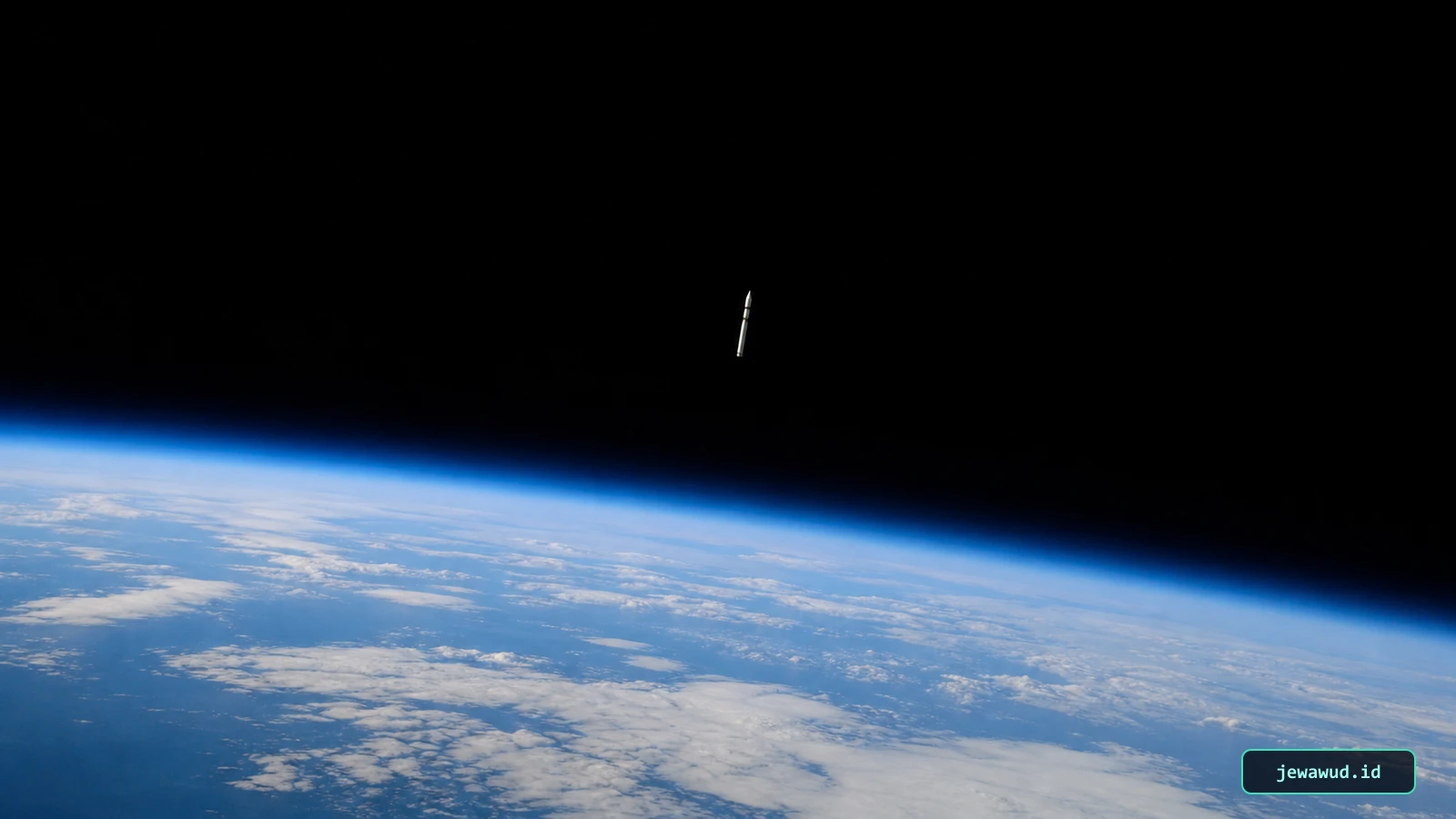
 Near 100 km the sky is black and the atmosphere is extremely thin, but the transition from air to space remains gradual
01What The Karman Line Actually Means
The Karman line is a conventional altitude used to separate aeronautics, flight supported primarily by the atmosphere, from astronautics, motion governed primarily by orbital mechanics. The Federation Aeronautique Internationale, or FAI, uses an altitude of 100 kilometers above mean sea level. That equals about 62.1 statute miles.
The line is named for aerospace engineer Theodore von Karman. The physical idea associated with his name asks what happens when an aircraft climbs into progressively thinner air. A wing produces lift by moving through a gas. As density falls, the vehicle must travel faster to generate the same aerodynamic force. At some altitude the speed required for aerodynamic support approaches orbital speed, so treating the vehicle as an aircraft becomes less meaningful than treating it as a spacecraft.
That reasoning describes a transition in the dominant mechanics, not a painted stripe around Earth. The modern 100 km value is a practical, round convention used for records, education, and public communication. Exact calculations depend on vehicle shape, wing loading, atmospheric conditions, and the criterion chosen. For that reason, the Karman line should be understood as a standard reference rather than a universal law of nature.
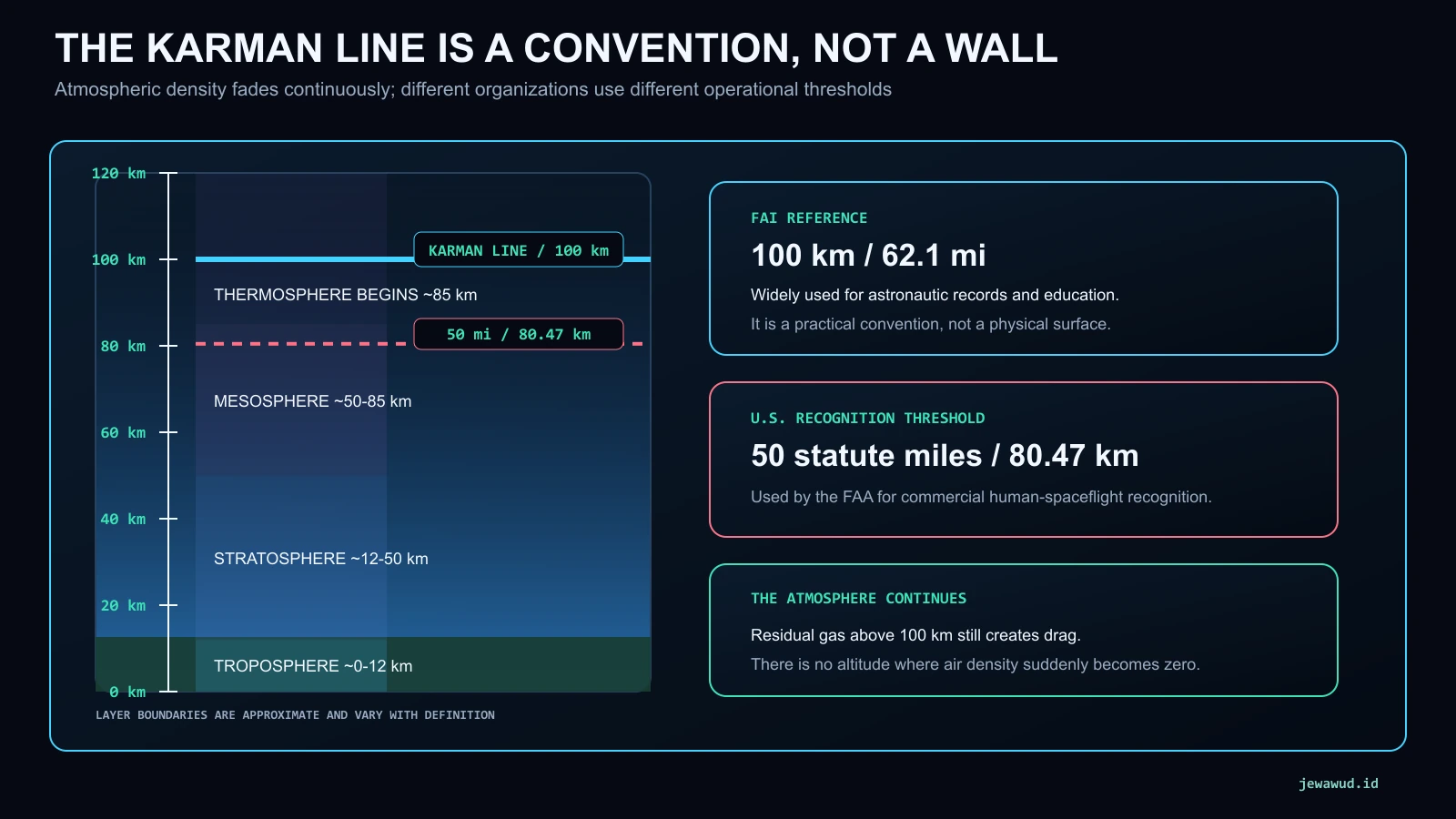 The 100 km FAI reference and the 50-mile U.S. threshold are conventions inside an atmosphere whose density fades continuously
02Why The Atmosphere Does Not End At 100 Km
Earth's atmosphere has no sharp upper surface. Molecules become less frequent with altitude, but the density does not suddenly drop to zero at 100 km. The Karman line lies near the transition from the upper mesosphere to the lower thermosphere, depending on the atmospheric model and how layer boundaries are defined. Above it, the thermosphere and exosphere continue for hundreds or thousands of kilometers.
This matters operationally. The International Space Station orbits at roughly 400 km, yet it still loses energy to residual atmospheric drag and periodically needs reboost maneuvers. Satellites at lower altitudes decay faster, while solar and geomagnetic activity can heat and expand the upper atmosphere, increasing drag even when the spacecraft's geometric altitude has not changed.
The visual transition is gradual too. From a high-altitude vehicle, the blue atmospheric limb thins into darkness. There is no flash or physical impact when a trajectory passes exactly 100.000 km. Instruments simply report that the chosen altitude threshold has been crossed. The vehicle still experiences gravity, and its future path still depends on velocity, flight-path angle, drag, and propulsion.
03Why 100 Km Is A Useful Boundary
A standard boundary makes records comparable. Without one, every organization could describe a different high-altitude flight as the first, highest, or longest spaceflight under its own definition. FAI adopted 100 km for astronautic records, and the number became familiar because it is close to the aerodynamic-to-orbital transition while remaining easy to remember and communicate.
The line also helps explain scale. One hundred kilometers sounds distant when measured vertically, but it is small compared with Earth's radius of about 6,371 km. On a true-scale globe, the Karman line would sit only about 1.6 percent of one Earth radius above the surface. Educational diagrams therefore exaggerate its separation from Earth so the label can be seen.
That exaggeration must be stated clearly. A thick glowing ring can help a reader locate 100 km, but it should never imply that the atmosphere forms a solid shell or that a spacecraft collides with a boundary. The altitude is a coordinate used by people; the vehicle responds only to the surrounding physical conditions.
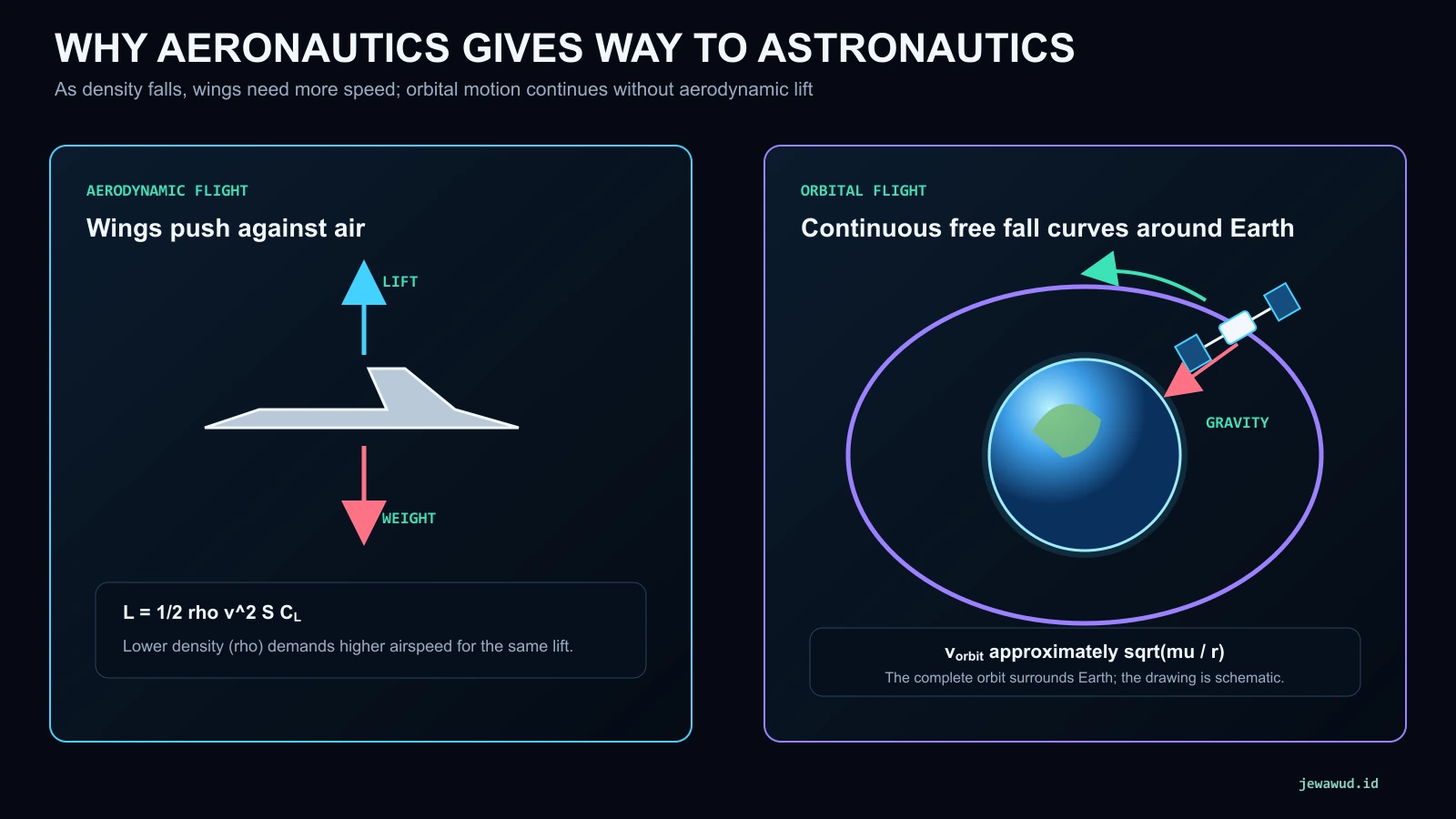 Aerodynamic flight requires enough air for wings to produce lift; orbital flight is continuous free fall around Earth
04The Physics Behind The Name
A simplified lift equation is L = 1/2 rho v2 S CL. Lift depends on atmospheric density rho, speed v, reference area S, and lift coefficient CL. When rho becomes extremely small, maintaining lift equal to weight requires a dramatic increase in speed, a larger wing, a higher lift coefficient, or some combination of all three. Real vehicles also face heating, stability, control, and structural limits.
Orbital motion uses a different principle. For an ideal circular orbit, speed is approximately v = sqrt(mu/r), where mu is Earth's gravitational parameter and r is distance from Earth's center. Near 100 km altitude the ideal circular speed is roughly 7.85 km/s, but such a low orbit would encounter enough atmosphere to decay extremely quickly. Practical sustained orbits are normally much higher.
The conceptual boundary appears where an aircraft would need speeds comparable to those associated with orbit just to remain aerodynamically supported. It is not determined by one fixed air-density measurement. Different assumptions produce different results, which is one reason modern discussions sometimes describe a transition region or Karman box rather than insisting that one mathematical calculation uniquely proves 100 km.
05Why The United States Also Uses 50 Miles
The 100 km value is widely recognized, but it is not the only threshold in use. The United States has historically recognized 50 statute miles, approximately 80.47 km, for some astronaut and human-spaceflight purposes. The FAA's current commercial human-spaceflight recognition page lists qualifying individuals who fly above 50 statute miles on an FAA-licensed or permitted launch.
This difference does not mean one side has found the real edge of space while the other is wrong. Both numbers are administrative and operational conventions applied to a gradual physical transition. An 85 km trajectory may qualify under a 50-mile rule but remain below the FAI 100 km record boundary.
Whenever a headline says someone "went to space," the useful follow-up is: under which definition? A careful report should state the maximum altitude and the recognizing organization instead of relying only on the word space. That distinction is especially important for suborbital tourism, experimental rocket flights, and historical astronaut records.
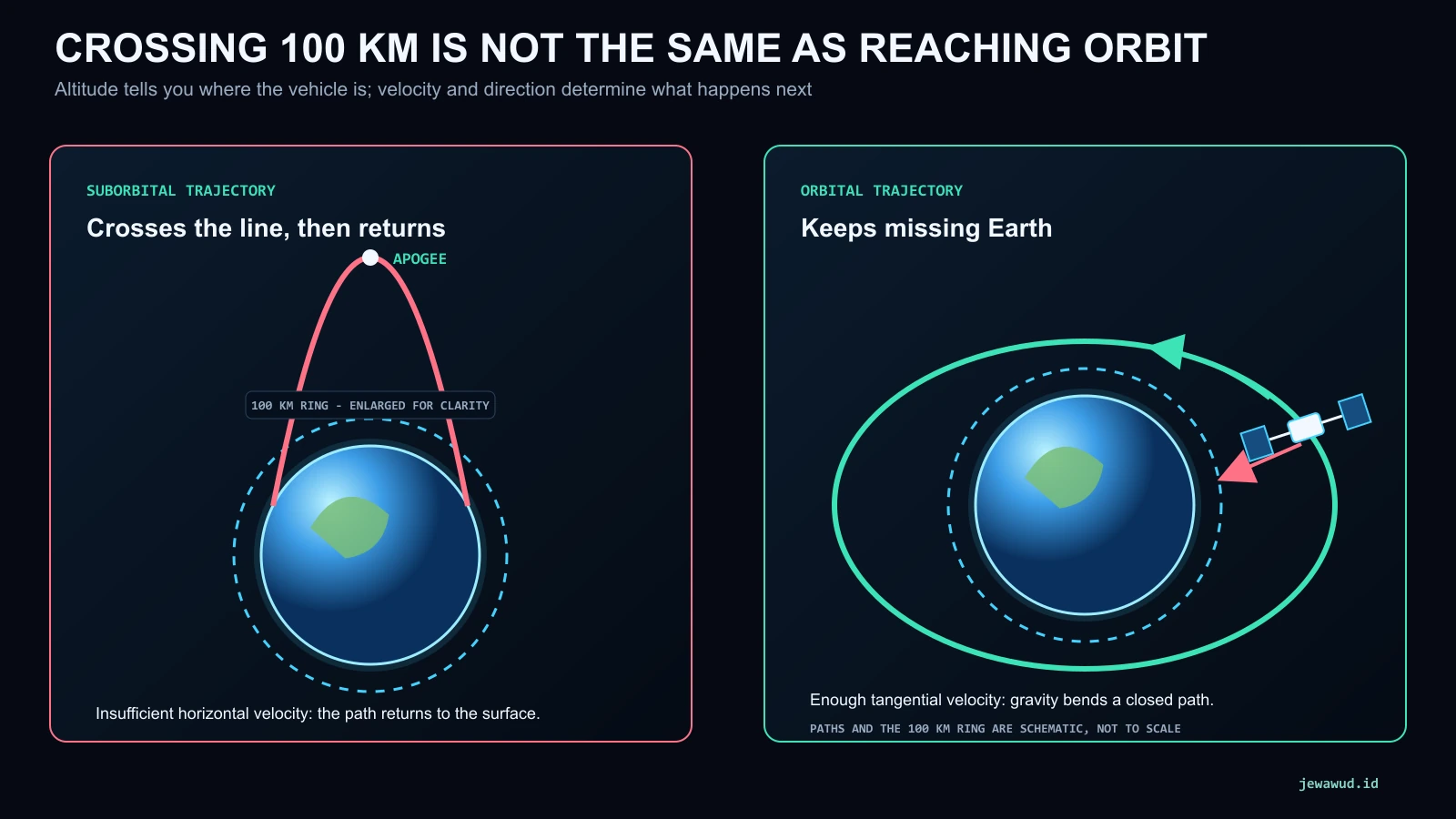 A suborbital vehicle may cross 100 km and return; a spacecraft reaches orbit only when sufficient tangential velocity keeps the path from intersecting Earth
06Crossing The Line Is Not Reaching Orbit
Altitude and orbit answer different questions. Altitude tells you how far the vehicle is above a reference surface. Orbit describes a trajectory whose sideways speed is high enough that gravity continuously curves the path around Earth. A sounding rocket can climb almost vertically above 100 km, coast to apogee, and then fall back near its launch region. It entered space under the 100 km convention but never completed an orbit.
An orbital launch vehicle gradually pitches away from vertical during ascent. The early vertical climb clears the launch structure and dense lower atmosphere. The later gravity turn builds horizontal velocity. Low Earth orbit requires roughly 7.7 to 7.9 km/s of inertial speed depending on altitude, before accounting for losses and Earth's rotation. Reaching 100 km with only a small horizontal component is therefore nowhere near enough.
This is why launch telemetry should never be judged by altitude alone. A vehicle at 150 km can still be on a path that intersects Earth, while a spacecraft at the same altitude with sufficient tangential speed may be in a temporary but rapidly decaying orbit. Perigee, apogee, velocity vector, and atmospheric drag all matter.
07Watching The Karman Line In Rocket Mission Simulator
Jewawud's Rocket Mission Simulator draws a labeled KARMAN LINE (100 km) across the flight view. Select the Falcon 9 preset and launch the mission. As the vehicle climbs, watch the altitude telemetry and the trajectory together. The line is a milestone in the ascent, not the end condition of the mission.
At the crossing, compare four readings. First, note the altitude. Second, inspect velocity rather than assuming height means orbit. Third, watch the flight-path direction: an orbital mission should be developing substantial downrange motion instead of continuing straight upward. Fourth, follow apogee and the orbital checks as the upper stage continues accelerating after it has passed 100 km.
The preset is an educational model, not certified flight-dynamics software or an exact reconstruction of a specific Falcon 9 mission. Its value is conceptual: it lets you see that the rocket can pass the Karman line while the mission still has a large velocity requirement ahead. Use time warp carefully when studying the crossing because high warp can make a short event appear instantaneous.
08How To Read A Launch Profile Correctly
A useful launch profile separates altitude milestones from energy milestones. Max Q describes peak dynamic pressure and usually occurs far below the Karman line. Main-engine cutoff and stage separation depend on the launch vehicle and mission. Passing 100 km is an altitude event. Orbit insertion is an energy and geometry event that occurs only after the vehicle has established an acceptable perigee, apogee, and velocity.
Velocity should also be split conceptually into vertical and horizontal components. Vertical velocity raises apogee. Horizontal velocity helps the vehicle keep missing Earth. A purely vertical launch can reach a spectacular altitude but must return unless another body captures it or propulsion changes the path. An orbital launch deliberately trades some vertical climb for tangential acceleration.
For related concepts, read Max Q Explained for the aerodynamic-load peak, Thrust-to-Weight Ratio Explained for liftoff acceleration, and Orbital Period Explained for the relationship between orbit size and period. Together they show why a launch cannot be described by one altitude number.
09Common Misconceptions
"There is no atmosphere above the Karman line." Residual atmosphere extends far higher and produces measurable drag on low-orbit satellites.
"Every organization defines space at exactly 100 km." FAI uses 100 km, while the United States has also used 50 statute miles for specific recognition programs.
"Crossing 100 km means the rocket is in orbit." A suborbital trajectory can cross the line and return. Orbit requires sufficient tangential velocity.
"Gravity becomes weak at 100 km." Gravitational acceleration there remains about 97 percent of its surface value. Astronauts feel weightless in orbit because they and their spacecraft are falling together, not because gravity has vanished.
"The Karman line is a legal border accepted by every treaty." International law does not provide one universally agreed altitude delimiting airspace and outer space. The 100 km line is influential, but its use depends on context.
10Primary References
The altitude convention and historical rationale were checked against the FAI explanation of the 100 km astronautic boundary and the FAI's later statement on scientific discussion around 80 and 100 km.
The gradual atmospheric transition was checked against NASA's overview of Earth's atmosphere and NASA JPL Education's Karman line lesson. The U.S. 50-mile recognition threshold is documented by the Federal Aviation Administration.
Watch 100 km become one milestone in a much longer ascent.
Launch the Falcon 9 preset, compare altitude with velocity, and follow the mission from liftoff toward orbital insertion.
Open Rocket Mission Simulator