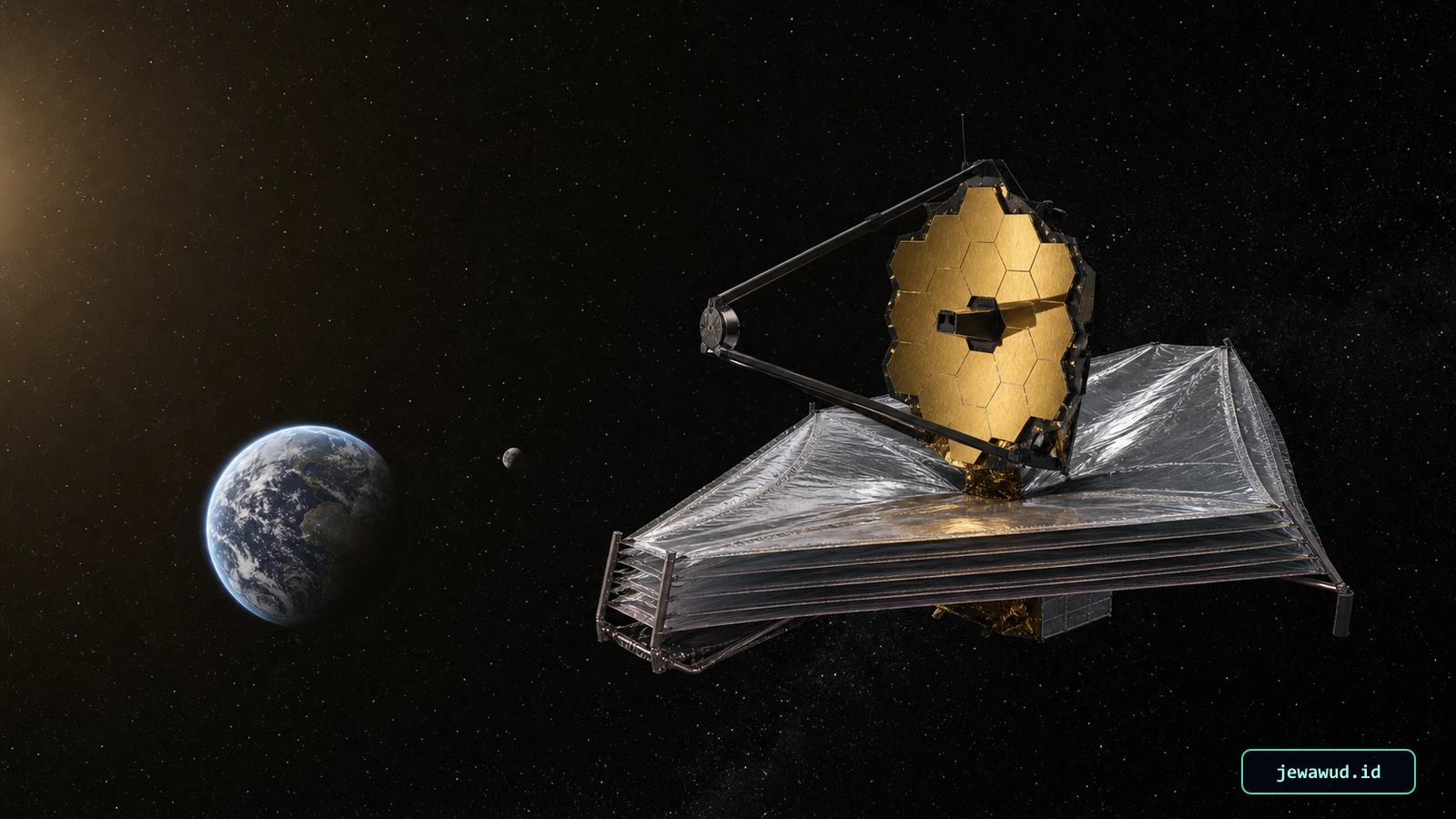
 Deep-space observatories can use the Sun-Earth L2 region to keep the Sun, Earth, and Moon on the protected side of a sunshield
01What A Lagrange Point Really Is
A Lagrange point is one of five equilibrium locations in the idealized circular restricted three-body problem. Two massive bodies, such as the Sun and Earth, orbit their common center of mass while a third object is assumed to be so small that it does not noticeably alter their motion. Viewed from a reference frame rotating with the two large bodies, five positions preserve the same geometry relative to both.
This does not mean gravity disappears or that the two gravitational pulls simply cancel everywhere. A spacecraft at a Lagrange region is still accelerating as it travels around the Sun, Earth, or another primary. The useful balance includes gravity from both massive bodies and the centripetal acceleration required to rotate with them. In the co-rotating frame, that combination appears as an equilibrium in an effective dynamical landscape.
The points depend on the chosen pair. The Sun-Earth system has its own L1 through L5, the Earth-Moon system has another five, and the Sun-Jupiter system has another set. Their physical distances change with the masses and separation of the pair, so a diagram that shows all five points clearly is almost always schematic rather than drawn to scale.
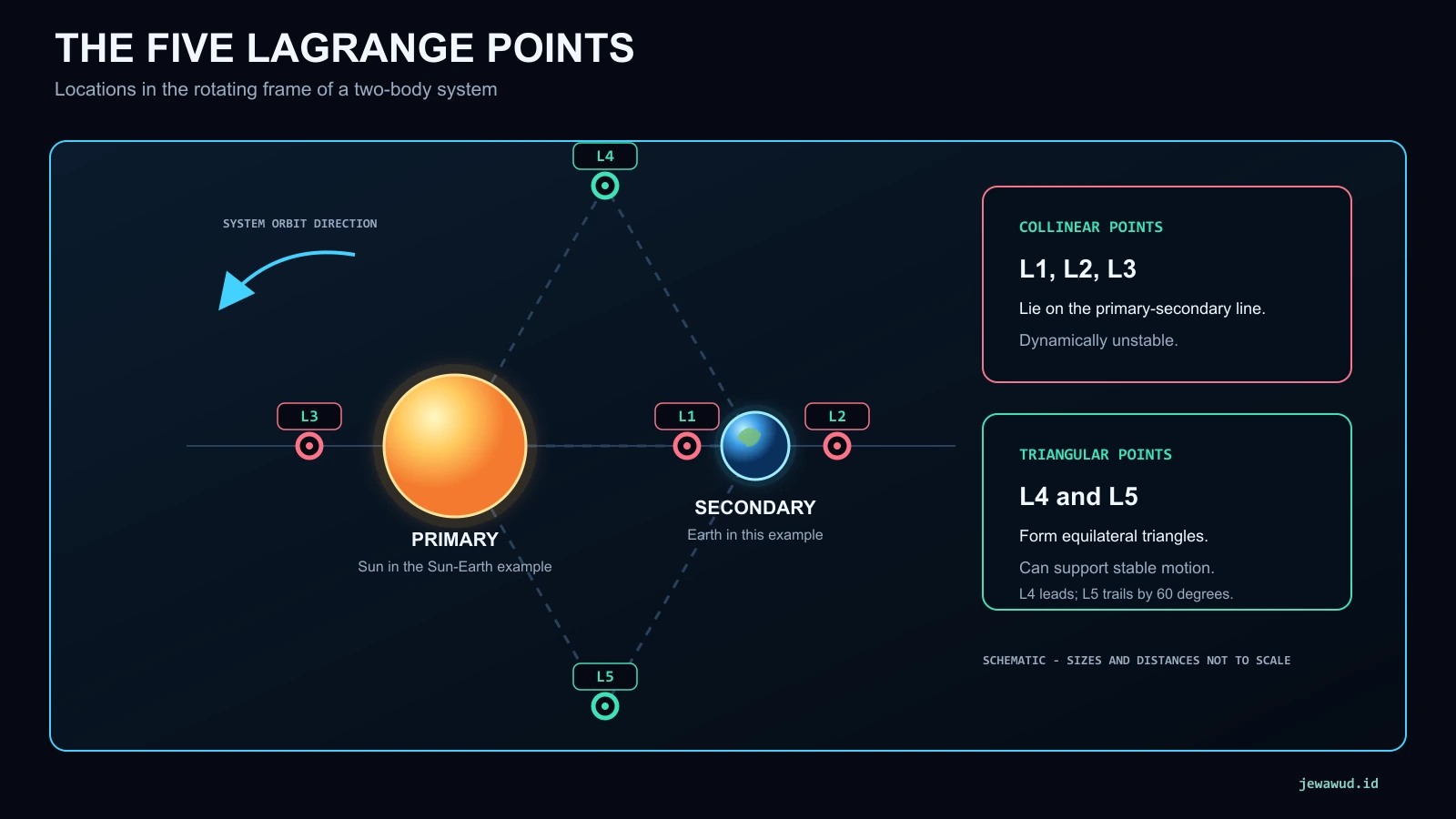 L1-L3 are collinear points; L4 and L5 sit at the third vertices of equilateral triangles in the rotating frame
02The Geometry Of L1 Through L5
L1 lies between the two large bodies. In the Sun-Earth system, it is roughly 1.5 million km from Earth toward the Sun. A spacecraft there feels a little more solar gravity than Earth does, but Earth's pull modifies the motion enough for the spacecraft to keep approximately the same one-year period as Earth. This makes L1 valuable for observing the Sun and measuring solar wind before it reaches Earth.
L2 lies beyond the secondary body, away from the primary. Sun-Earth L2 is also roughly 1.5 million km from Earth. An object that far from the Sun would normally orbit a little more slowly than Earth, but the additional pull from Earth changes the required acceleration. The result is a region that can travel around the Sun with the same mean angular rate as Earth.
L3 lies beyond the primary, opposite the secondary. In the Sun-Earth case it stays on the far side of the Sun from Earth and offers few practical advantages for communication or observation. L4 leads the secondary by 60 degrees and L5 trails it by 60 degrees. Each triangular point forms an equilateral triangle with the primary and secondary in the rotating frame.
03Why A Rotating Frame Helps
In an inertial view, the Sun, Earth, spacecraft, and every Lagrange region sweep continuously around the Sun. Nothing is physically nailed to space. The geometry is easier to understand in a coordinate system that rotates once per year with Earth. In that frame, the Sun and Earth appear fixed, and the five equilibrium locations also appear fixed.
The rotating description introduces apparent centrifugal and Coriolis effects. Mathematically, analysts combine these with the gravitational potential to form an effective potential and use the Jacobi integral to examine allowed motion. The balance at a Lagrange point is therefore a property of a rotating three-body system, not a two-force tug-of-war sketched on a straight line.
Real mission design goes beyond this circular idealization. Planetary orbits are eccentric, the Moon and other planets perturb the spacecraft, solar radiation pressure acts on large surfaces, and navigation errors accumulate. High-fidelity trajectory propagation numerically integrates these effects and plans correction maneuvers around an intended reference orbit.
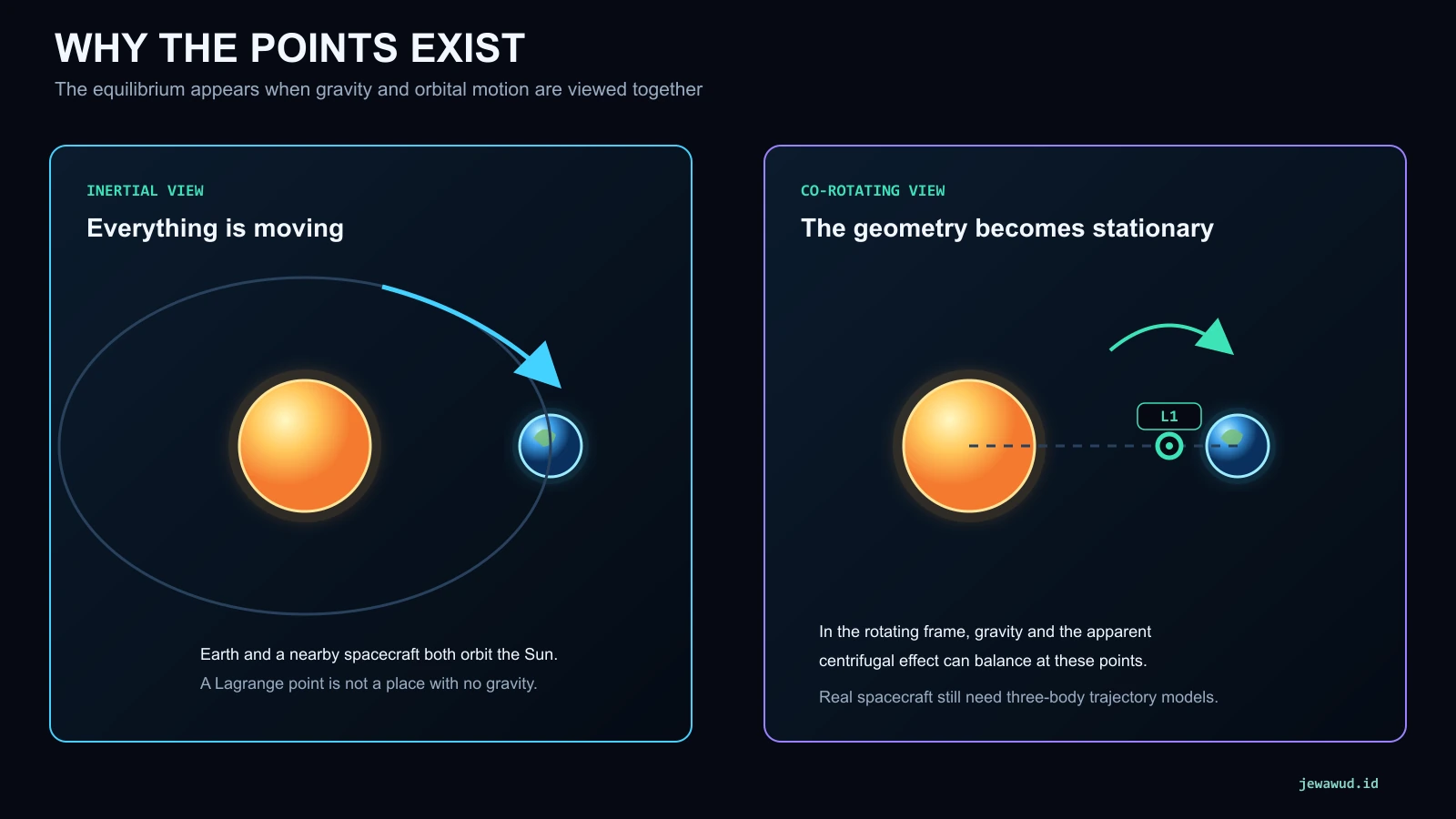 The equilibrium is easiest to see in the co-rotating frame, but the entire system continues orbiting in inertial space
04Why L1, L2, And L3 Are Unstable
L1, L2, and L3 are equilibrium points, but they are dynamically unstable. A small position or velocity error generally grows rather than naturally returning the object to the exact equilibrium. The situation is often compared with balancing near a saddle: it can be controlled, but it does not passively correct every displacement.
That instability does not make these regions useless. Mission designers select periodic or quasi-periodic trajectories around them and budget propellant for stationkeeping. The motion can take the form of a halo orbit, a Lissajous trajectory, or another three-body orbit family. Ground navigation estimates the spacecraft state, predicts its departure from the reference path, and commands small burns before the error becomes large.
The fuel requirement can still be modest compared with fighting to hold an arbitrary position in space. Mission lifetime depends on launch injection accuracy, orbit design, spacecraft disturbances, navigation strategy, thruster performance, and the propellant carried for momentum management and stationkeeping.
05Why L4 And L5 Can Be Stable
L4 and L5 behave differently. When the primary is sufficiently more massive than the secondary, small objects near the triangular points can execute bounded motion instead of immediately drifting away. The classic stability requirement corresponds to a primary-to-secondary mass ratio greater than about 24.96 in the ideal circular model. The Sun-Earth and Sun-Jupiter systems easily satisfy that condition.
The stabilizing behavior cannot be understood from a static gravity picture alone. In the rotating frame, a displaced object begins to move, and the Coriolis effect curves that motion into paths around the triangular region. Depending on energy and initial conditions, these may resemble tadpole or horseshoe orbits rather than tiny circles centered precisely on L4 or L5.
Jupiter's Trojan asteroids provide the best-known natural example. They share Jupiter's orbit around the Sun while clustering around the L4 and L5 regions. They are not sitting on single mathematical coordinates; each follows its own librating orbit through a broad swarm. NASA's Lucy mission is designed to encounter objects in both Trojan populations.
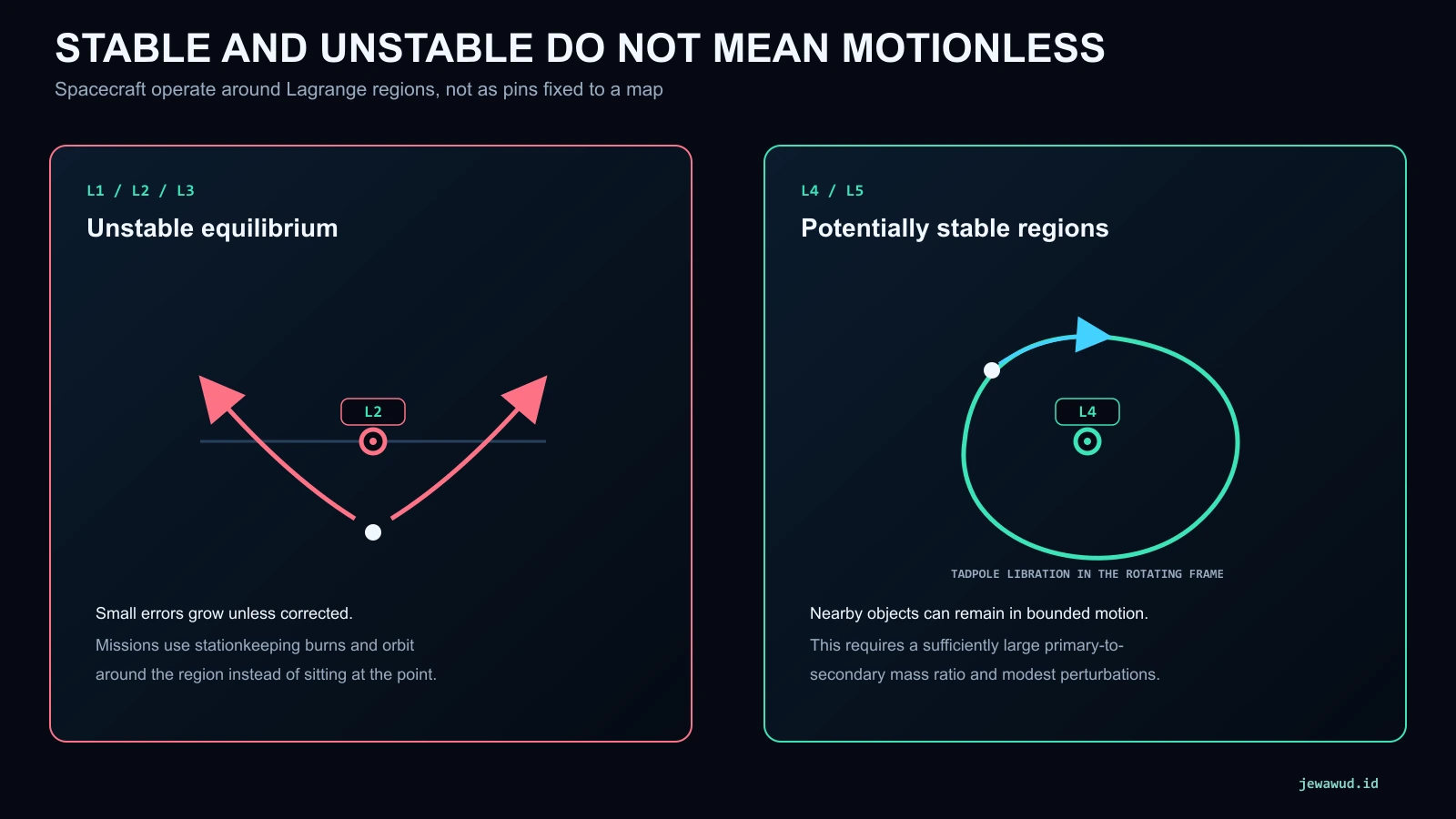 Stable means nearby motion can remain bounded under the right conditions; it does not mean an object is perfectly motionless
06Webb Does Not Sit At L2
The James Webb Space Telescope is commonly described as being "at L2," but the shorthand hides important geometry. Webb follows a large halo orbit around the Sun-Earth L2 region, not a small Earth-centered orbit and not a fixed point. NASA states that Webb completes one circuit around L2 in about 168 days while also traveling around the Sun with Earth once per year.
This trajectory keeps the Sun, Earth, and Moon on the same general side of the observatory. Webb can orient its multilayer sunshield toward those warm, bright bodies while the telescope looks into cold deep space. The halo orbit is designed to avoid extended passage through Earth's or the Moon's shadow, preserving solar power and reducing thermal disturbances.
L2 is also close enough for routine communication through the Deep Space Network, although 1.5 million km is nearly four times the average Earth-Moon distance. Webb periodically fires thrusters to maintain its orbit. Because it cannot turn around without exposing the optics and instruments to sunlight, mission planners also carefully manage momentum and propellant.
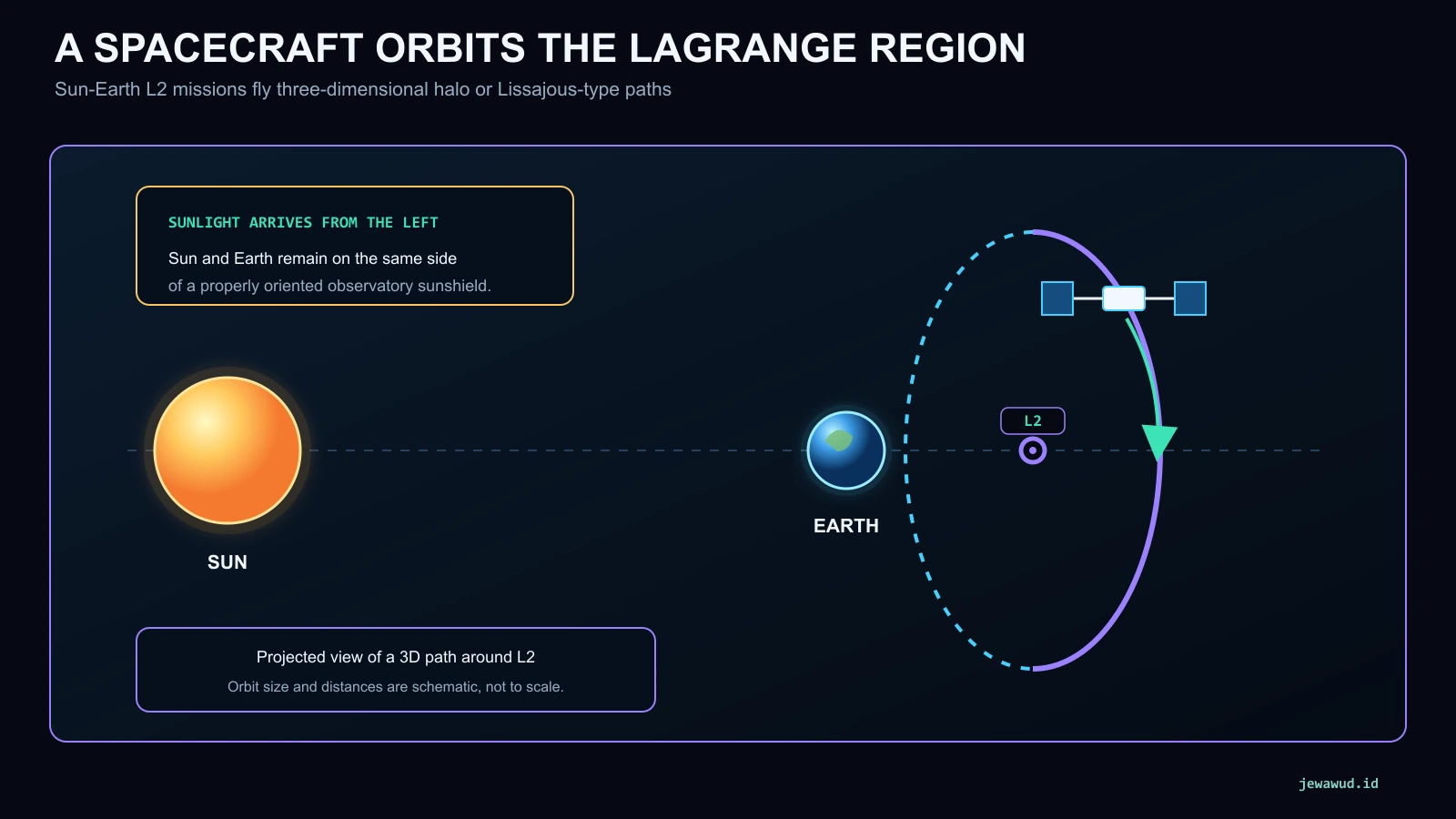 A halo orbit is a three-dimensional path around the L2 region; the complete Earth-L2 system continues around the Sun
07Real Missions At L1 And L2
Sun-Earth L1 is an upstream monitoring location for space weather. DSCOVR and other solar observatories can sample the solar wind before it reaches Earth, giving forecasters useful warning time for geomagnetic disturbances. The Solar and Heliospheric Observatory, SOHO, also operates around L1 and maintains a nearly continuous view of the Sun.
Sun-Earth L2 is attractive for astronomy because the bright Sun, Earth, and Moon remain grouped in one direction while much of the sky is accessible over time. Webb is the most familiar example, while earlier observatories such as WMAP, Herschel, and Planck also used trajectories around L2. Different missions occupy distinct large paths; L2 is a broad operational region, not a crowded physical parking bay.
Earth-Moon Lagrange regions are increasingly important in studies of lunar navigation, communications, transfers, and cislunar infrastructure. Their dynamics differ from the Sun-Earth case because the mass ratio, period, distances, and perturbations are different. A trajectory useful around Sun-Earth L2 cannot simply be rescaled and flown around Earth-Moon L2 without a new analysis.
08How A Mission Reaches A Lagrange Orbit
A launch vehicle first injects the spacecraft onto an escape or high-energy transfer trajectory. The spacecraft then performs correction maneuvers to target the chosen invariant-manifold or transfer corridor toward the Lagrange region. Arrival is usually gentle compared with capture into a low circular orbit because there is no solid body to orbit and no single impulsive insertion that works for every orbit family.
For Webb, engineers deliberately targeted a trajectory that arrived slightly short of the final energy and then added carefully controlled velocity with mid-course burns. This strategy protected the observatory: Webb can thrust in only certain directions without risking contamination or sunshield orientation, so an overshoot would have been difficult to correct.
The process resembles the phasing logic discussed in Orbital Rendezvous and Phasing, but the dynamics are genuinely three-body. Keplerian elements and two-body transfers remain useful intuition, while the final solution relies on numerical propagation, targeting, covariance analysis, and repeated navigation updates.
09Common Misconceptions
"Gravity cancels at every Lagrange point." It does not. At L4 and L5, the gravity vectors are not even opposite. The equilibrium emerges from the complete rotating dynamics.
"A spacecraft parked there needs no fuel." L1-L3 missions require stationkeeping, while even motion near L4-L5 can be disturbed by other bodies, radiation pressure, and navigation errors.
"L2 is an orbit around Earth." Webb's primary orbit is heliocentric. Its halo motion is superimposed on the annual Sun-centered path shared with the Earth-L2 geometry.
"Every object at L4 or L5 sits exactly 60 degrees away." Real Trojans librate through broad regions around the ideal points. The mathematical point is the center of a dynamical neighborhood, not a hook holding each asteroid in place.
"Lagrange points are fixed coordinates." Their locations move with the two defining bodies. Sun-Earth L1 follows Earth around the Sun; it is not fixed against the stars.
10Reading The Diagrams Correctly
Educational diagrams enlarge the distance between Earth and L1 or L2 so that labels remain readable. They may also show a halo orbit in projection, even though the real path is three-dimensional and its orientation evolves in the Sun-Earth rotating frame. Always check whether a figure is inertial or co-rotating and whether sizes and distances are to scale.
For a broader foundation, read Orbital Period Explained to see why orbital angular rate changes with distance, then continue to Six Orbital Elements Explained for the geometry of ordinary two-body orbits. Lagrange-region trajectories require a more advanced model, but those concepts remain essential for understanding their transfers and observations.
The central idea is simple even when the mathematics is not: a spacecraft can exploit the moving gravitational architecture of two large bodies. The result is not a motionless point, but a family of controlled or naturally bounded paths that make otherwise difficult missions practical.
11Primary References
The technical statements and mission examples in this guide were checked against official material from NASA's Lagrange point overview, NASA's Webb L2 orbit guide, NASA's DSCOVR mission profile, and NASA's Lucy mission FAQ.
Follow the mechanics behind the mission.
Explore orbital periods, rendezvous, ground tracks, and spacecraft systems across Jewawud's visual guides.
Browse All Articles