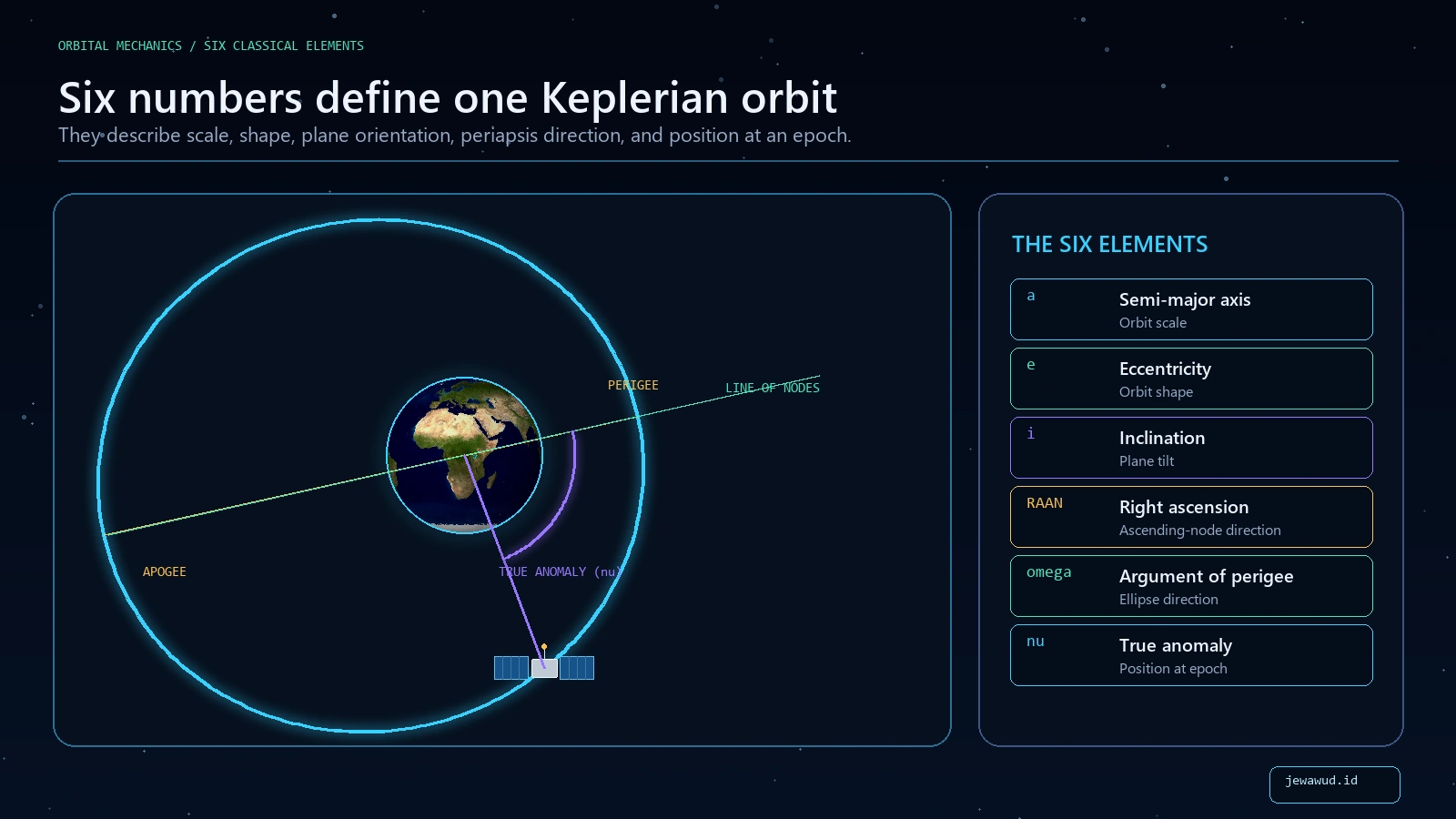
 The six elements define orbit size, shape, plane orientation, periapsis direction, and position at an epoch
01Why One Altitude Is Not Enough
Saying that a satellite is “at 500 kilometers” does not describe its orbit. The value may tell us an approximate height above Earth, but it does not reveal whether the path is circular or elliptical, whether it crosses the equator, which direction the orbital plane faces, where the lowest point lies, or where the satellite is right now.
Orbital mechanics solves that ambiguity with a compact coordinate system called the classical orbital elements, also known as Keplerian elements. The common set is semi-major axis (a), eccentricity (e), inclination (i), right ascension of the ascending node (RAAN, Ω), argument of perigee (ω), and an anomaly that places the spacecraft on the orbit. Together they answer four questions: How large is the orbit? What shape is it? How is it oriented in space? Where is the satellite at the reference time?
These are not six independent decorations on an orbit diagram. Each removes a different freedom of motion. The first two define an ellipse, the next three turn that ellipse into the correct three-dimensional orientation, and the final element identifies a point on the path.
02The Reference System Comes First
Six numbers alone are incomplete. They must be tied to a central body, a reference plane, a reference direction, and an epoch. For Earth satellites, the center of Earth is normally the origin, Earth’s equatorial plane is the reference plane, and a conventional direction in inertial space provides the zero point from which RAAN is measured.
The epoch is the timestamp at which the elements apply. This matters because real orbits change. Earth is not a perfect sphere, the upper atmosphere creates drag, the Moon and Sun perturb the path, and spacecraft sometimes maneuver. An element set without its epoch is like a weather report without a date.
Orbital elements are usually expressed in an Earth-centered inertial frame before software transforms the resulting state into Earth-fixed latitude and longitude. That transformation is why a satellite can follow a stable plane in space while its ground track shifts across a rotating Earth.
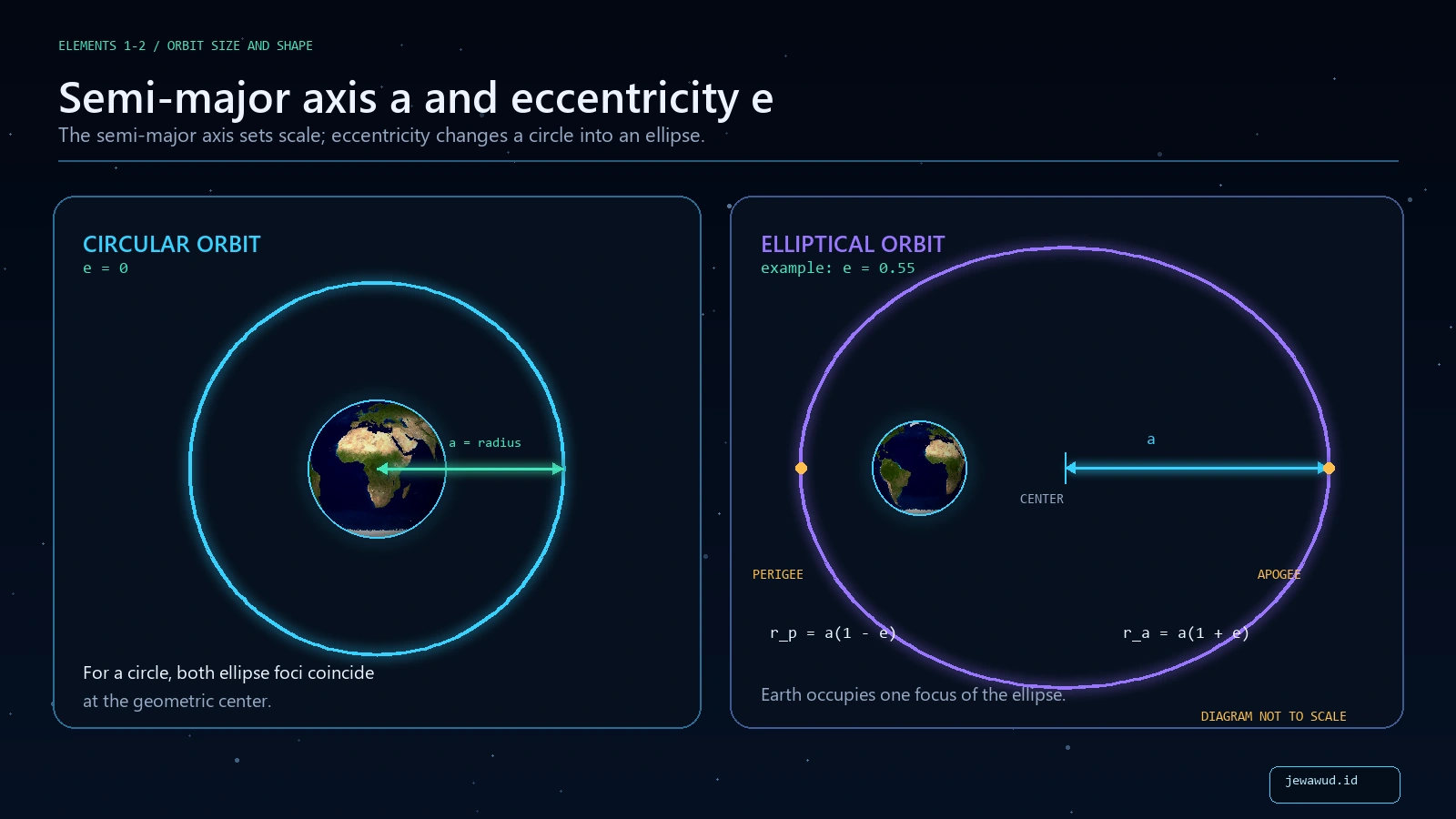 Semi-major axis measures scale from the ellipse center; perigee and apogee radii are measured from Earth at one focus
03Semi-Major Axis: The Size
The semi-major axis, written a, is half the longest diameter of an ellipse. It is the fundamental measure of orbital size. For a circular orbit, the semi-major axis is simply the orbital radius. For an elliptical orbit, it is the average of the perigee and apogee radii measured from Earth’s center.
This distinction is easy to miss: semi-major axis is not altitude above the surface. A circular satellite at 400 kilometers altitude has a semi-major axis of roughly Earth’s radius plus 400 kilometers, or about 6,771 kilometers. Using altitude where a physics formula expects orbital radius produces a large error.
Orbital size is tied directly to energy and period. A larger semi-major axis means a longer orbital period and a lower average angular rate. This is why low Earth orbit spacecraft circle Earth in roughly 90 to 130 minutes, while a geostationary satellite at a much larger semi-major axis takes one sidereal day. For more context, see Orbital Altitude Explained.
04Eccentricity: The Shape
Eccentricity, written e, describes how far an orbit departs from a circle. A value of zero is circular. Values between zero and one describe bound elliptical orbits. As eccentricity grows, the separation between the nearest point, called perigee, and the farthest point, called apogee, becomes larger.
For an Earth-centered ellipse, the perigee radius is a(1 − e) and the apogee radius is a(1 + e). Subtract Earth’s radius to convert those radii into approximate altitudes. This pairing shows why semi-major axis and eccentricity must be read together: the same eccentricity applied to two different semi-major axes produces very different physical orbits.
A satellite also changes speed around an ellipse. It moves fastest near perigee and slowest near apogee. The orbit is therefore not a circular animation with its center dragged sideways; Earth occupies one focus of the ellipse, and the spacecraft’s speed changes continuously as orbital energy trades between kinetic and gravitational potential energy.
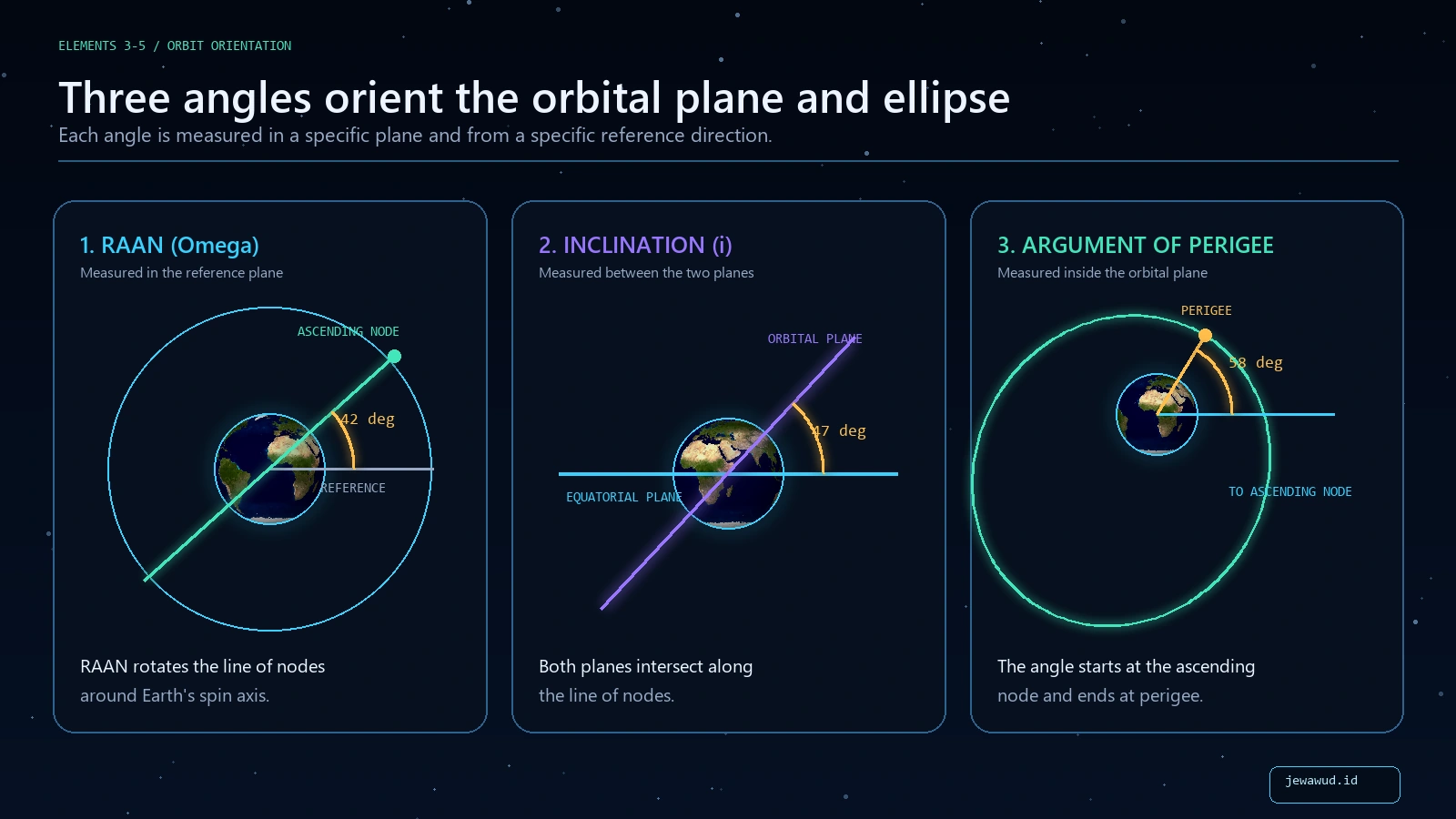 RAAN is measured in the reference plane, inclination between planes, and argument of perigee inside the orbital plane
05Inclination: The Tilt
Inclination, written i, is the angle between the orbital plane and Earth’s equatorial plane. A zero-degree orbit lies in the equatorial plane and travels prograde. An inclination near 90 degrees is polar. Values above 90 degrees describe retrograde motion relative to Earth’s rotation.
Inclination limits the highest and lowest latitudes reached by the subsatellite point. The International Space Station’s inclination of about 51.6 degrees allows its ground track to range roughly between 51.6° north and 51.6° south. It does not pass directly over the poles. Sun-synchronous Earth-observation missions commonly use near-polar, slightly retrograde inclinations.
Inclination tells us how much the plane is tilted, but not which way the tilted plane faces. Many different orbital planes can share the same inclination. That missing orientation is supplied by RAAN. A deeper treatment is available in Understanding Orbital Inclination.
06RAAN: Which Way the Plane Faces
An inclined orbit crosses Earth’s equatorial plane at two points called nodes. The ascending node is the crossing where the satellite moves from south to north; the descending node is the north-to-south crossing. The line joining them is the line of nodes.
Right ascension of the ascending node, or RAAN, is written with the capital Greek letter omega, Ω. It measures the angle in the reference plane from the reference direction to the ascending node. In plain language, RAAN rotates the entire orbital plane around Earth’s axis.
Two satellites can have identical semi-major axis, eccentricity, and inclination yet occupy different planes because their RAAN values differ. Constellations use this deliberately: several planes with similar inclination and evenly separated RAAN values distribute coverage around Earth. RAAN also changes gradually under Earth’s oblateness, an effect mission designers can exploit to maintain a Sun-synchronous orbit.
07Argument of Perigee: Where the Ellipse Points
Once the orbital plane is fixed, an eccentric ellipse can still rotate inside that plane. Argument of perigee, written with lowercase omega, ω, removes this final orientation freedom. It is measured in the direction of motion from the ascending node to perigee.
This element determines where the low and high portions of an elliptical orbit occur relative to the equator. If argument of perigee changes while the other orientation elements remain fixed, the orbital plane does not move; the ellipse pivots within that plane. Highly elliptical communications or science missions can place apogee over a desired hemisphere by choosing this orientation carefully.
The similar symbols Ω and ω cause frequent confusion. Capital Ω locates the ascending node and turns the plane around Earth. Lowercase ω starts at that node and locates perigee within the plane. Reading them in that order—first Ω, then ω—helps reconstruct the geometry.
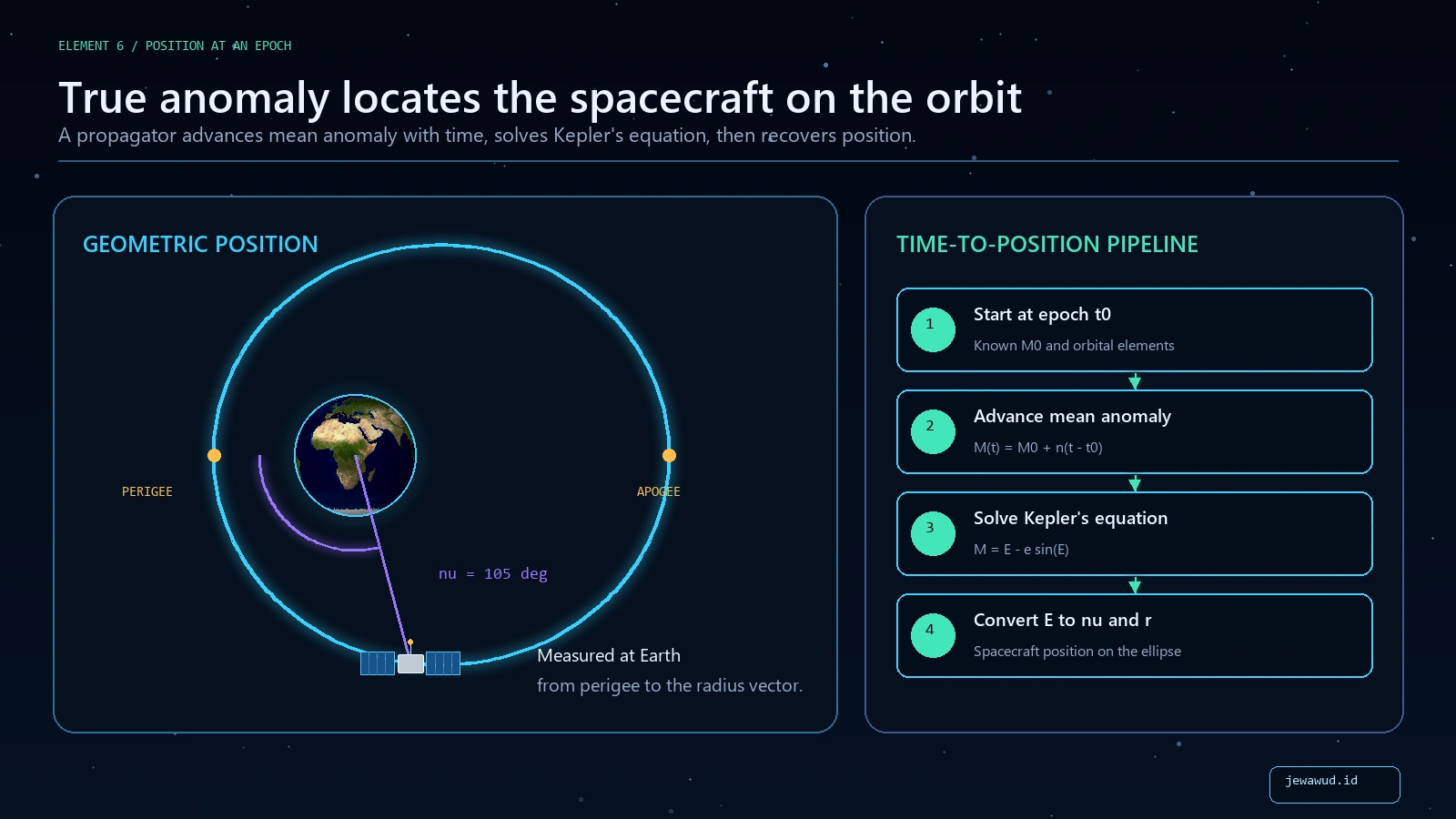 True anomaly is measured at Earth from perigee to the spacecraft; mean anomaly supplies the uniform time parameter
08Anomaly: Where the Satellite Is
The first five elements define a complete path, but the satellite could be anywhere on it. The sixth element locates the spacecraft at the epoch. In a direct geometric description this is often true anomaly, ν: the angle measured at the focus from perigee to the spacecraft’s current radius vector.
True anomaly corresponds to a visible point on the ellipse, but it does not increase uniformly with time. Near perigee the spacecraft moves quickly, so true anomaly changes rapidly; near apogee it changes more slowly. Orbit calculations therefore also use mean anomaly, M, an angle that advances uniformly with time for the equivalent Keplerian motion.
A Two-Line Element set (TLE) contains mean anomaly at epoch rather than true anomaly. It also contains mean motion, from which a characteristic semi-major axis can be inferred. An orbit propagator advances that state to the requested time and computes the satellite’s position and velocity. The phrase “six orbital elements” can therefore refer to a geometric set ending in true anomaly or a time-oriented set ending in mean anomaly; the context and data format determine which is intended.
09Mean Elements Versus Osculating Elements
A further distinction matters in real tracking. Osculating elements describe the instantaneous Keplerian ellipse that is tangent to the spacecraft’s actual position and velocity at one moment. Because perturbations continually change that instantaneous ellipse, osculating values can fluctuate over short periods.
Mean elements smooth selected short-period variations. TLE values are mean elements fitted for use with the SGP4 model; they should not be treated as generic osculating Keplerian elements and inserted into an unrelated two-body propagator. The definitions and force assumptions belong together.
This is one reason two reputable data products can show slightly different element values for the same satellite. They may use different epochs, reference conventions, estimation methods, or definitions of mean versus osculating elements. A useful comparison must hold those choices constant.
10From TLE to a Dot in JOT
In Jewawud Orbital Tracker (JOT), the visible dot is the end of a calculation chain. JOT reads a TLE and its epoch, passes the mean elements to SGP4, requests a state at the current UTC time, converts the inertial result into an Earth-fixed frame, and finally derives latitude, longitude, altitude, and screen coordinates.
The displayed orbit line should use the same object and propagation chain sampled at many timestamps. This keeps the selected marker anchored to the correct trajectory. The ground track is a different projection: it shows where the moving radius vector intersects the rotating Earth, so it forms a wave on a flat map rather than a fixed ellipse.
When a tracker shows RAAN, inclination, or mean anomaly, those values are not arbitrary telemetry labels. They are compact pieces of the geometry behind every rendered position. Understanding them lets a visitor move beyond “a dot is moving” and ask why that satellite reaches certain latitudes, why its next pass shifts west or east, and why two similar-altitude objects occupy different orbital planes.
11Special Cases and Ambiguous Angles
Classical elements are intuitive, but they develop mathematical singularities in special cases. In a perfectly circular orbit, every point is equally close to Earth, so perigee has no unique direction and argument of perigee becomes undefined. In a perfectly equatorial orbit, the orbit never crosses the equatorial reference plane, so there is no unique ascending node and RAAN becomes undefined.
Software handles these cases with combined angles or alternative element sets. Argument of latitude can replace the separate perigee and true-anomaly angles for circular inclined orbits. True longitude can locate an object in circular equatorial cases. Equinoctial and Cartesian state representations are often preferred in numerical systems because they behave smoothly near these singularities.
The orbit itself is not broken. Only the chosen coordinate description has lost a unique reference. This is similar to longitude at Earth’s geographic poles: the location exists, but one familiar coordinate becomes ambiguous.
12A Practical Reading Order
When you encounter an element table, read it in layers. First inspect epoch and reference system. Then read a and e to understand scale, period, perigee, and apogee. Read i and Ω to understand the plane and latitude coverage. Read ω to locate perigee within that plane. Finally read ν or M to locate the satellite at the epoch.
Do not judge an orbit from one number. A high inclination does not mean a high altitude. A large semi-major axis does not imply a circular path. An identical altitude and inclination do not mean two satellites share the same plane. The value of the element set comes from the combination.
For an interactive intuition, use the Orbital Planner to compare orbit scales and open JOT to inspect how real catalog objects translate orbital data into moving positions.
FAQQuick Questions
Are six orbital elements enough to predict a satellite forever? No. They define a state at an epoch within a chosen model. Real perturbations, drag, maneuvers, and estimation uncertainty make updated data and propagation necessary.
Is semi-major axis the same as altitude? No. Semi-major axis is measured from the center of the central body. Altitude is measured above a reference surface.
Why does a TLE use mean anomaly instead of true anomaly? Mean anomaly advances uniformly in the underlying Keplerian timing model and fits the mean-element formulation used by SGP4. The instantaneous geometric position can be derived during propagation.
Which element determines the satellite’s latitude coverage? Inclination sets the ideal maximum geocentric latitude reached by the orbit, while the actual ground track also depends on Earth’s rotation and orbital timing.
REFPrimary References
NASA’s Basics of Space Flight, Chapter 5 introduces the quantities and reference geometry used to specify an orbit.
NASA’s Orbits and Kepler’s Laws explains ellipses, semi-major axis, eccentricity, and the relationship between orbital size and period.
The NASA Marshall Space Flight Center Chandra orbital elements reference shows the classical elements in a practical spacecraft data table.
NASA Earth Observatory’s Catalog of Earth Satellite Orbits connects altitude, eccentricity, inclination, and mission coverage.
NASA CNEOS defines the geometric meaning of true anomaly.
Turn the Elements Into Motion
Open JOT to inspect real catalog objects, then compare the orbit’s inclination, altitude, and propagated path on the live globe.
Open Jewawud Orbital Tracker