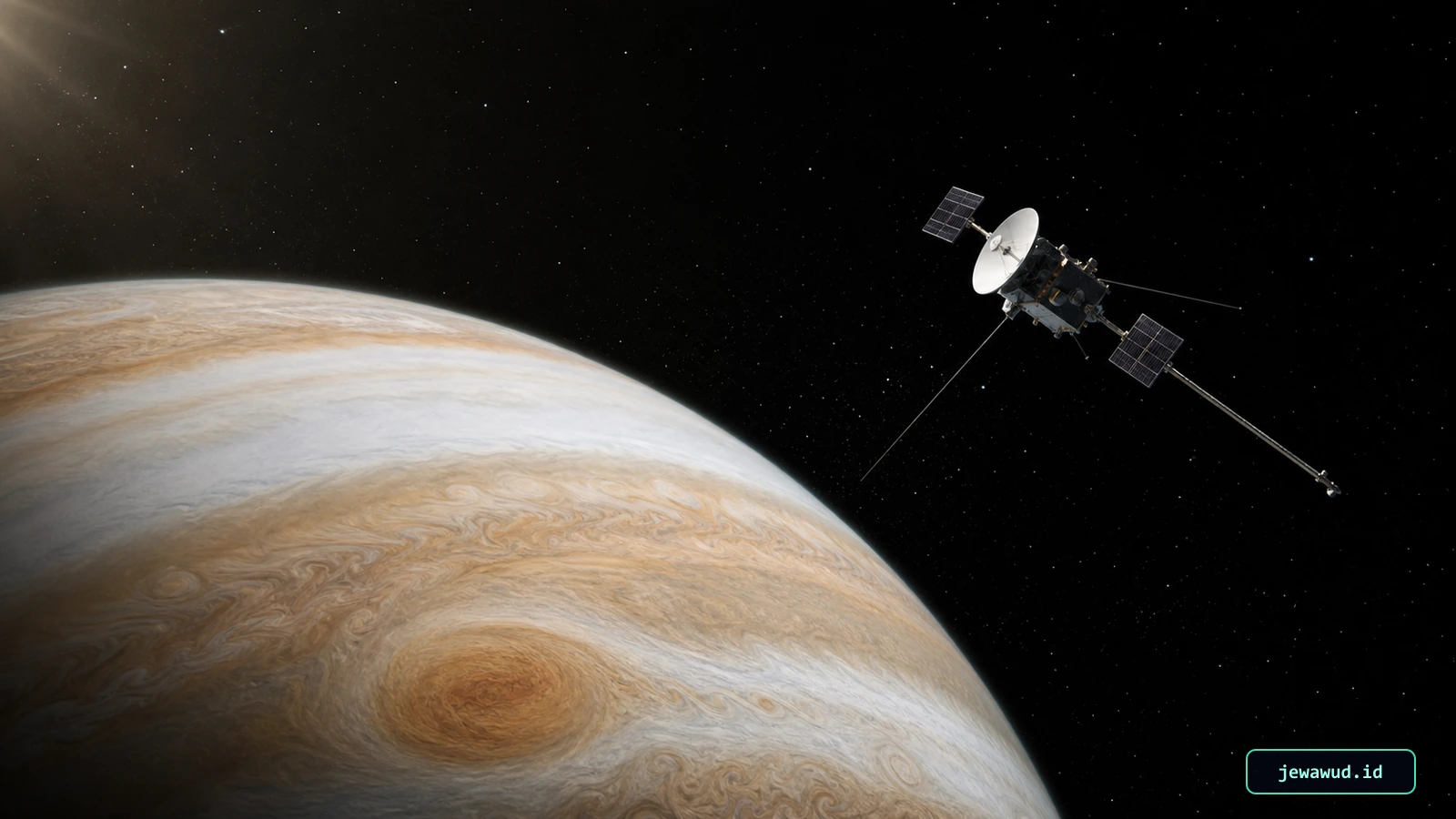
 A gravity assist uses a moving planet's gravity to redirect a spacecraft; the result depends on both flyby geometry and reference frame
01What A Gravity Assist Actually Does
A gravity assist, also called a gravitational slingshot or swing-by, is a close planetary or lunar flyby designed to change a spacecraft's trajectory. The spacecraft falls into the body's gravity well, accelerates as it approaches, curves around the body, and climbs away along a new direction. Mission designers use that bend to alter the spacecraft's orbit around the Sun or another central body.
The maneuver is more subtle than the common picture of a planet simply pulling a spacecraft forward. In the planet-centered view, an ideal unpowered flyby mainly rotates the spacecraft's velocity vector. In the Sun-centered view, that rotated vector is combined with the planet's own orbital velocity. The resulting heliocentric velocity can be larger, smaller, or pointed in a strategically different direction.
This technique saves propellant because a rocket engine does not have to produce the entire change in velocity. It does not remove the need for launch energy, navigation burns, or trajectory corrections, and it cannot connect arbitrary destinations at arbitrary dates. The planets must be in useful positions, the approach geometry must be safe, and the encounter must lead toward the next target.
02The Flyby In The Planet's Frame
Imagine watching the encounter from a reference frame traveling with the planet. Far before arrival, the spacecraft approaches with a hyperbolic excess velocity called v∞ or "v-infinity." It follows one branch of a hyperbola, passes periapsis at its closest safe distance, and departs along the other branch.
As the spacecraft descends, gravitational potential energy becomes kinetic energy and its speed rises. As it climbs away, the process reverses. In the ideal two-body, unpowered model, the incoming and outgoing asymptotic speeds have the same magnitude: |v∞,in| = |v∞,out|. What changes is direction. The angle between those asymptotes is the flyby turn angle.
This is why saying "the planet accelerated the spacecraft" is incomplete. Near periapsis, the spacecraft certainly moves faster than it did far away, but much of that local increase is surrendered during departure. The lasting mission benefit appears when the rotated planet-relative velocity is transformed back into the Sun-centered frame.
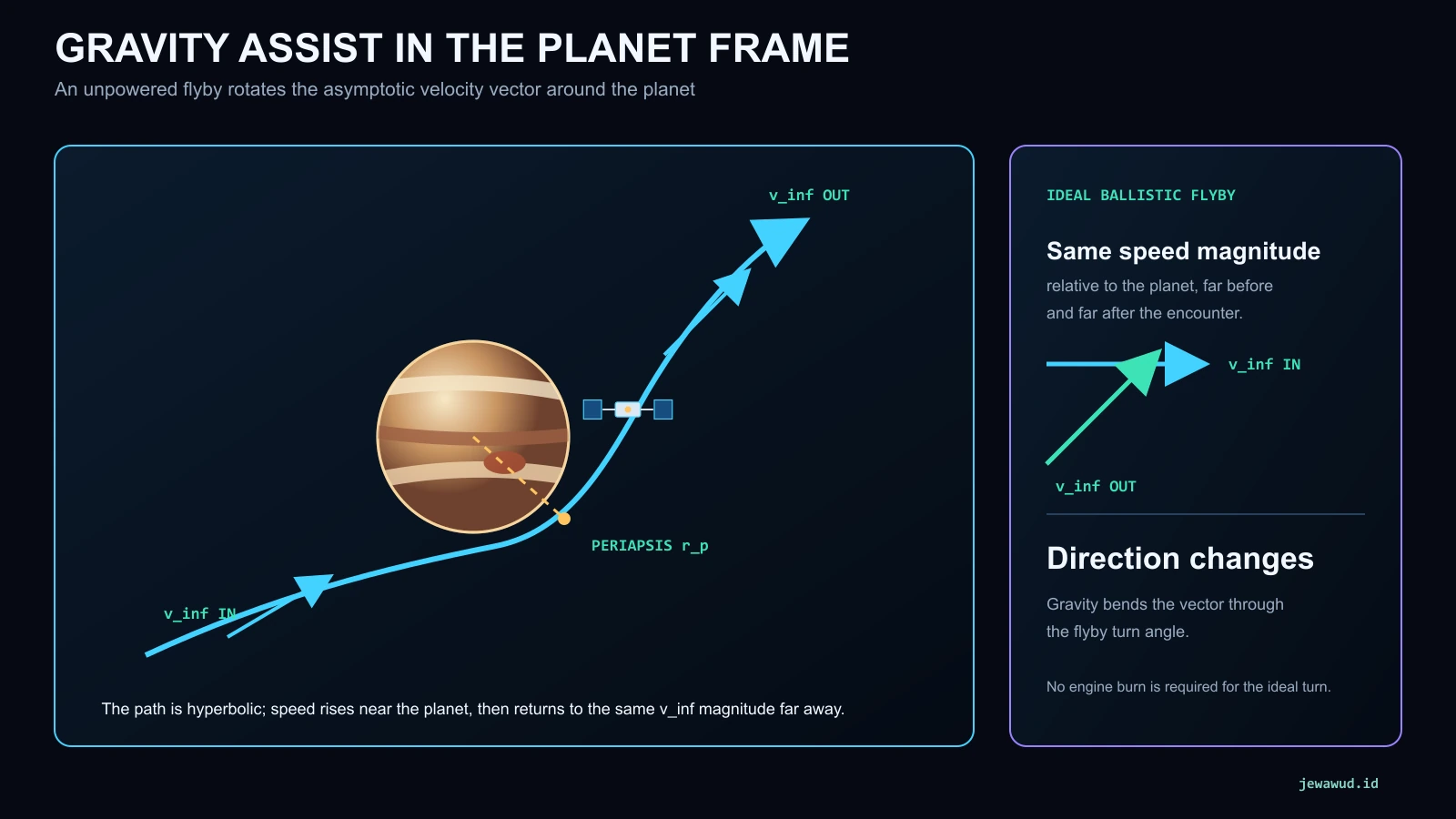 In the ideal planet-centered model, gravity changes the direction of v-infinity while preserving its far-field magnitude
03Why The Sun-Centered Answer Changes
A planet is not stationary. Earth travels around the Sun at roughly 30 km/s, Jupiter at roughly 13 km/s, and every other planet carries its own orbital velocity. To obtain the spacecraft's heliocentric velocity, mission analysts add the planet's heliocentric velocity vector to the spacecraft's planet-relative vector:
Vspacecraft = Vplanet + v∞
Before and after the flyby, the planet vector is nearly the same over the short encounter, while v∞ has rotated. Adding the same planet vector to two differently directed v∞ vectors produces different Sun-relative results. This reference-frame transformation is the central idea behind a gravity assist.
A useful analogy is a ball bouncing from a moving train, but the analogy has limits: a gravity assist is a smooth gravitational interaction rather than a collision. The full problem involves the Sun, planet, and spacecraft. Patched-conic mission design approximates the heliocentric legs and planet-centered hyperbola separately, then more precise numerical models account for simultaneous forces and perturbations.
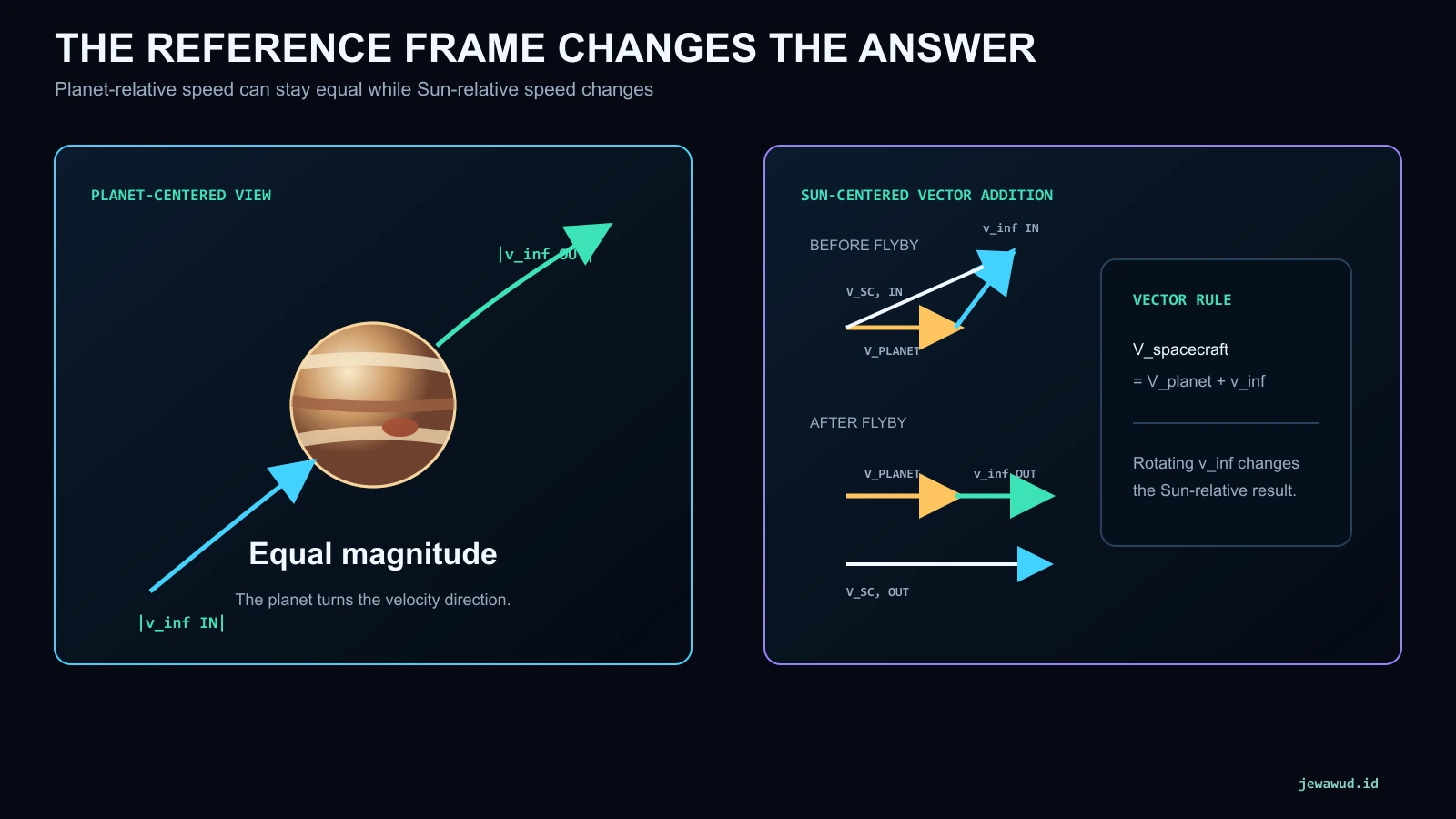 The same planet velocity is added to a rotated v-infinity vector, changing the spacecraft's heliocentric velocity
04Boost, Brake, Or Redirect
In a simplified coplanar encounter, passing behind the planet relative to its orbital motion can rotate the outgoing velocity more along the planet's motion. The spacecraft then leaves with greater heliocentric orbital energy and can reach a larger solar orbit. This is the familiar outward-bound "slingshot" used by many missions to the outer planets.
Passing ahead of the moving planet can have the opposite effect. The outgoing vector can be rotated against the planet's motion, reducing the spacecraft's heliocentric orbital energy. That is not a failed gravity assist; it is deliberate braking. Reaching Mercury or approaching the Sun is difficult because a spacecraft launched from Earth inherits Earth's large sideways velocity around the Sun. Removing heliocentric energy can be more demanding than simply falling inward.
Not every useful flyby is best described as a pure boost or brake. A mission may need to change inclination, rotate the orbital plane, target another planet, adjust arrival conditions, or reshape the orbit while changing speed only modestly. Three-dimensional encounter geometry determines how the available turn is distributed among these objectives.
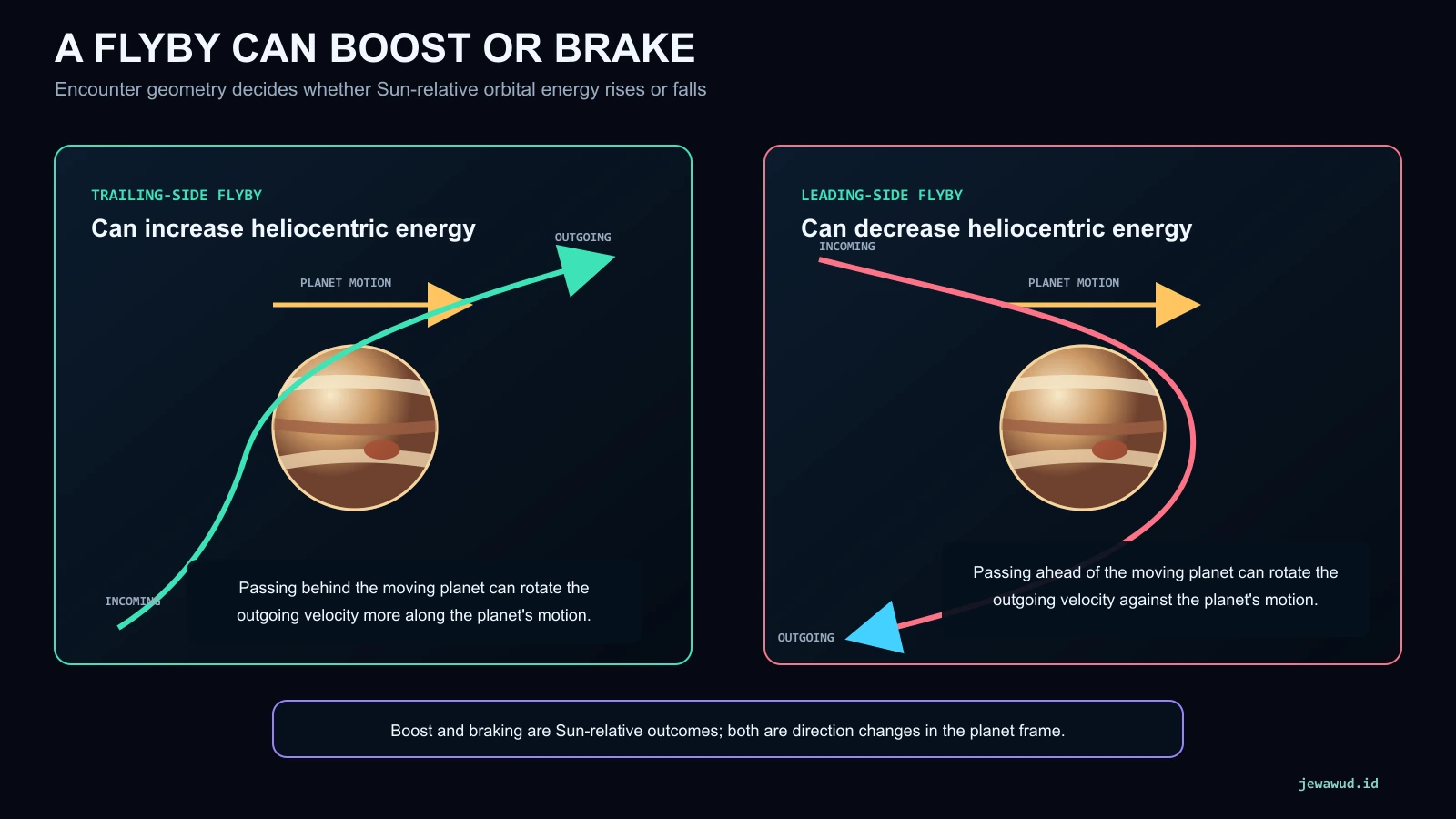 Boost and braking describe Sun-relative outcomes; both begin as a direction change in the planet-centered frame
05What Controls The Turn Angle
The amount of bending is not arbitrary. For an ideal hyperbolic flyby, the turn angle δ can be related to hyperbolic eccentricity e through δ = 2 sin-1(1/e). A convenient form for the eccentricity is e = 1 + rpv∞2/μ, where rp is periapsis radius measured from the body's center and μ is its gravitational parameter.
A more massive body with a larger gravitational parameter can produce stronger deflection. A lower incoming v∞ gives gravity more time to turn the trajectory. A smaller periapsis radius also increases bending because the spacecraft passes deeper into the gravity well. These variables are linked: a fast arrival may require an impractically close approach to obtain a large turn.
The mathematical radius is constrained by the real planet. A flyby must remain above dangerous atmosphere and terrain while avoiding rings, moons, radiation environments, excessive heating, occultation restrictions, and navigation uncertainty. Engineers include statistical dispersions and safety margins, so the planned closest approach is not simply the smallest geometrically possible value.
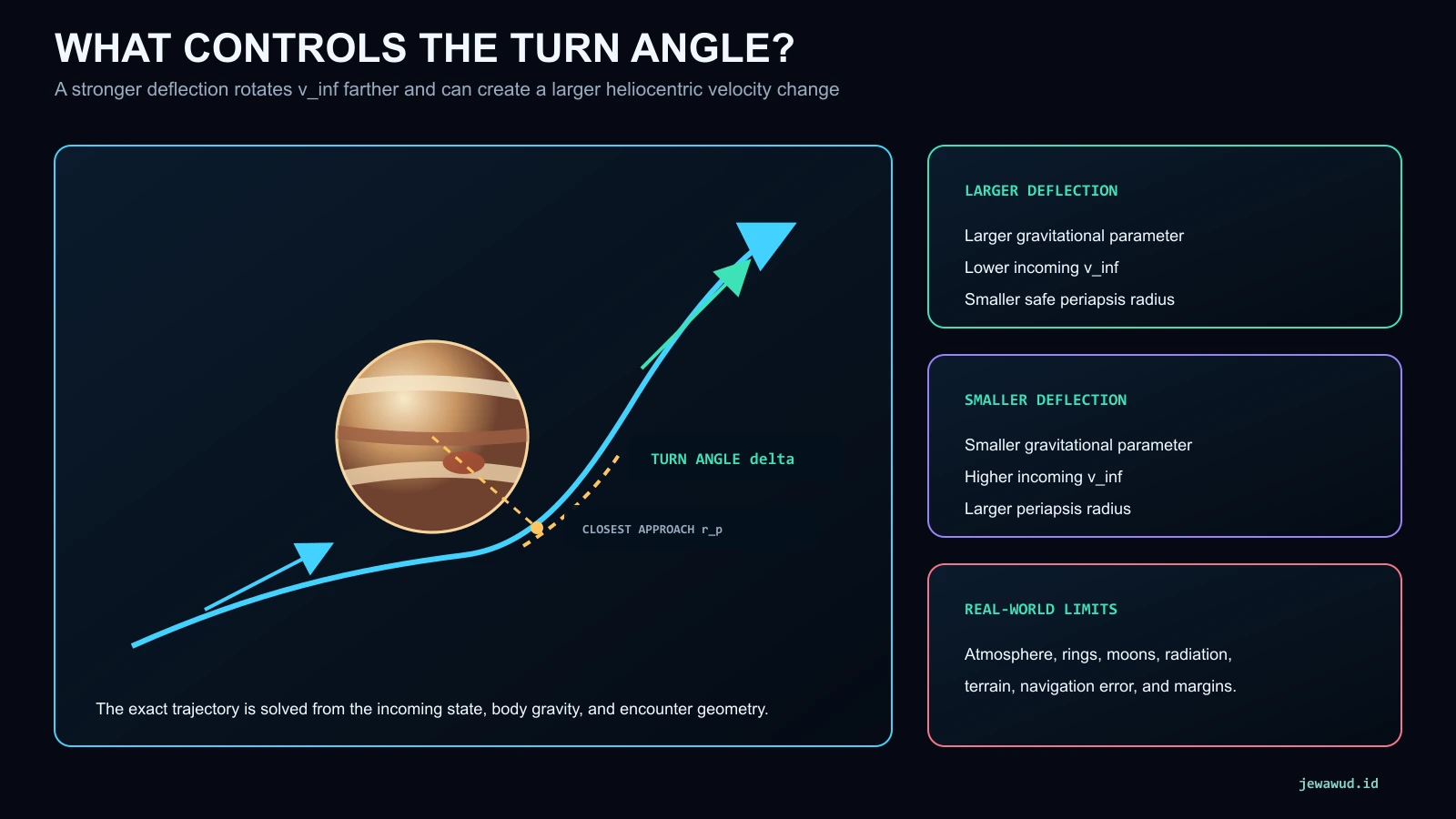 Turn angle grows with stronger gravity, lower v-infinity, and a closer safe periapsis, subject to real mission limits
06No Violation Of Conservation Laws
A gravity assist does not create energy from nothing. In the Sun-centered system, the spacecraft exchanges momentum and orbital energy with the planet. If the spacecraft gains heliocentric energy, the planet loses an equal amount; if the spacecraft is braked, the planet gains it. Because a planet is enormously more massive than a spacecraft, the resulting change in the planet's orbit is far too small to matter operationally.
In the ideal planet-centered approximation, the flyby is elastic in the sense that the magnitude of v∞ is unchanged. In the heliocentric frame, the moving planet supplies the reference-frame-dependent energy exchange. Both descriptions are compatible because kinetic energy depends on reference frame while momentum and energy remain conserved for the complete interacting system.
An engine burn near periapsis can be combined with a flyby. That becomes a powered gravity assist, and a burn made where the spacecraft is moving fastest can exploit the Oberth effect. The rocket burn and gravitational turn should then be counted separately: gravity redirects the trajectory, while propulsion deliberately changes the spacecraft's specific orbital energy.
07Landmark Gravity-Assist Missions
Mariner 10 became the first mission to use a planetary gravity assist, flying past Venus in 1974 to redirect its trajectory toward Mercury. The technique enabled three Mercury encounters, although the spacecraft returned with the same side of Mercury illuminated because of the encounter geometry and orbital resonance.
Voyager 1 and Voyager 2 exploited a rare outer-planet alignment. Jupiter and Saturn encounters accelerated and redirected both spacecraft; Voyager 2 continued to Uranus and Neptune. The sequence did more than save propellant. Each encounter targeted the next planet, turning a set of isolated flybys into an interplanetary chain. You can inspect the spacecraft configurations in the Voyager 3D Explorer and read the companion Voyager Mission guide.
Cassini-Huygens used a Venus-Venus-Earth-Jupiter gravity-assist sequence, often abbreviated VVEJGA, to reach Saturn with a spacecraft too massive for a direct launch on the available rocket. Later, repeated Titan flybys reshaped Cassini's Saturn-centered orbit, demonstrating that gravity assists are equally powerful inside a planetary system.
Parker Solar Probe uses repeated Venus gravity assists as brakes. Each carefully timed encounter removes heliocentric orbital energy and lowers perihelion, allowing Parker to approach the Sun more closely than chemical propulsion alone could practically achieve after launch from Earth.
08Navigation: A Small Target In Deep Space
A useful gravity assist requires much more precision than merely reaching the planet. Navigators target a location in the encounter plane called the B-plane, an imaginary plane perpendicular to the incoming asymptote. The selected point controls the flyby altitude, side of passage, turn direction, and outgoing trajectory.
Radio tracking, optical navigation, orbit determination, and trajectory-correction maneuvers progressively shrink the arrival uncertainty. A small error before encounter can become a large miss at the next destination because the planetary flyby amplifies directional differences. Corrections are generally cheaper when made early, but late maneuvers may be needed to remove residual error.
Launch windows are therefore tied to a complete encounter chain. Earth departure must place the spacecraft on a trajectory that reaches the first body at the correct time and geometry; that flyby must then aim at the next encounter. A delay may change the entire sequence rather than just shift every event by a few days. The Launch Windows Explained article examines the timing problem, while Delta-v Explained covers the propulsion budget that gravity assists help conserve.
09Common Misconceptions
"The spacecraft steals gravity." Gravity is not consumed. The spacecraft exchanges an extremely small amount of momentum and orbital energy with the moving planet.
"Every flyby increases speed." A gravity assist can boost, brake, rotate the orbital plane, or primarily redirect the path. Speed must always be stated relative to a frame, such as the planet or the Sun.
"The spacecraft loops around the planet." Most gravity assists are open hyperbolic flybys, not captured orbits. The spacecraft approaches from far away and leaves again unless propulsion or another interaction removes enough energy for capture.
"A closer pass is always better." Closer approaches can increase deflection, but atmosphere, terrain, rings, moons, radiation, heating, communication geometry, and navigation margins set hard limits.
"Gravity assist replaces propulsion." Launch, course correction, attitude control, targeting, and many arrival maneuvers still require propulsion. Gravity assist is one component of an integrated mission design.
10References And Further Reading
NASA Science: Gravity Assist Primer explains the equal planet-relative asymptotic speed and the Sun-relative vector change.
NASA Basics of Space Flight: Interplanetary Trajectories introduces launch opportunities, transfer paths, and planetary flybys.
NASA/JPL: Mariner 10 documents the first planetary gravity assist and the mission's Venus-to-Mercury trajectory.
NASA Science: Cassini Gravity Assists describes Cassini's interplanetary VVEJGA sequence and Saturn-system flybys.
NASA: Parker Solar Probe Changed the Game explains why repeated Venus flybys reduce Parker's heliocentric energy.
NASA Technical Reports Server: Galileo Gravity-Assist Geometry provides a technical treatment of planet-centered hyperbolas, v-infinity, and heliocentric vector addition.