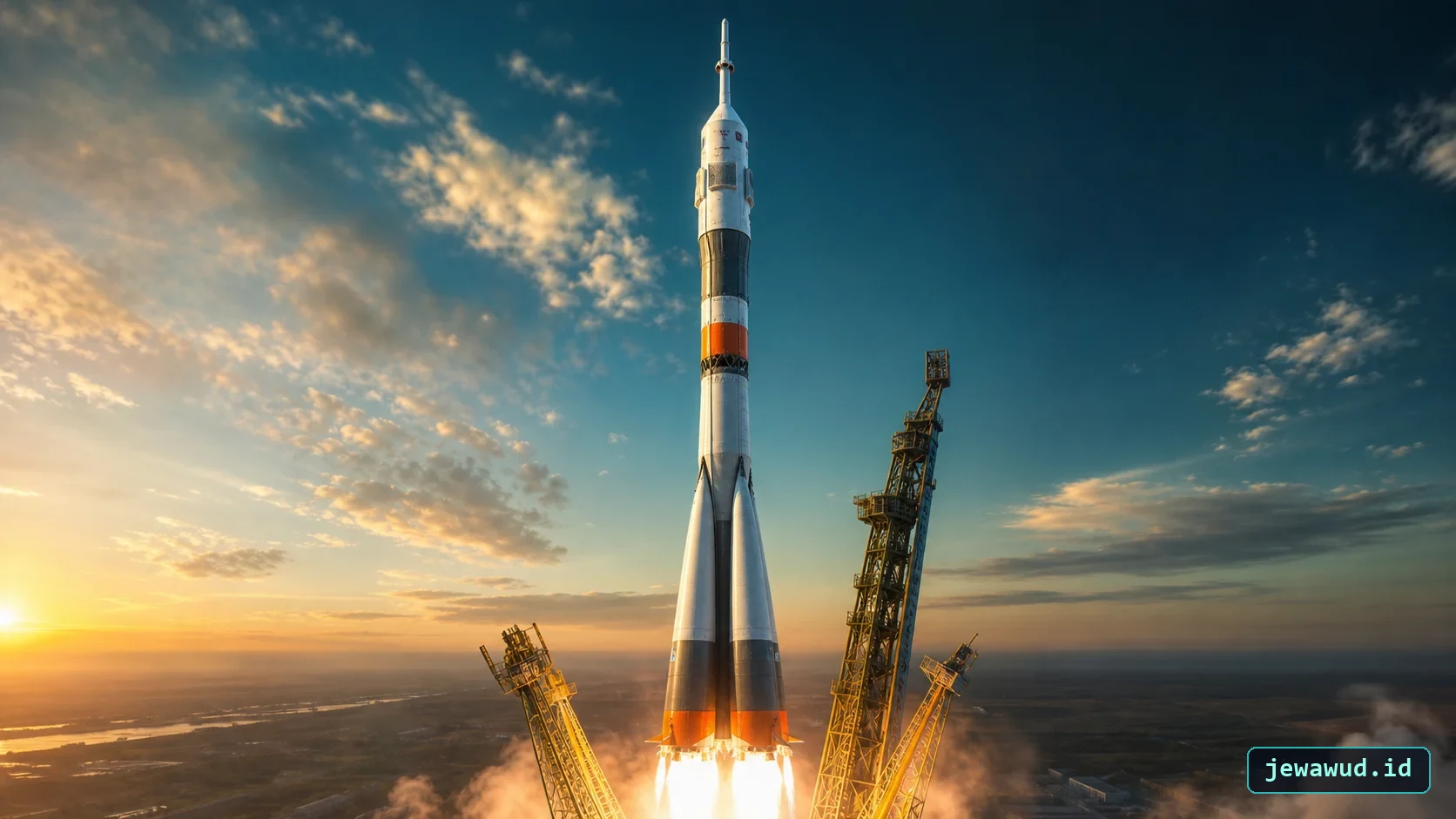
 Four side boosters surround the central core; this illustration is not a scale drawing.
01Why The Stage Numbers Can Be Confusing
The familiar Soyuz outline has four tapered boosters around a long central core. Calling the core the second stage can make it sound as though it waits on the pad with its engine off. It does not. In this architecture, the boosters and core start together; the boosters finish their part first.
ESA identifies the hardware as four first-stage boosters, the Block A second stage and the Block I third stage. A Fregat upper stage can be added above them. The word "stage" needs its vehicle context: the core is physically central, but second in the separation sequence.
This guide covers the familiar four-booster layout, not every vehicle carrying the Soyuz name. It also separates the launch vehicle from the Soyuz crew spacecraft. A crew capsule, a satellite fairing and a Fregat stage are not interchangeable names for the top of the rocket.
Four side boosters
First stage: provide thrust alongside the core at liftoff, then separate.
Block A core
Second stage: starts with the boosters and continues after they leave.
Block I
Third stage: accelerates the remaining upper stack after the core.
Fregat, when fitted
Additional upper stage: performs mission-specific burns before releasing its payload.
Source: ESA: Soyuz components · jewawud.id
02Two Different Engine Handoffs
ESA's Gaia launch preparation account describes the first and second stages igniting together. Booster separation therefore does not require the core to start from rest: it is already contributing thrust. Look for the four departing side bodies and the central vehicle continuing upward.
The next handoff uses hot staging. Block I ignites before the core has fully separated, rather than waiting for a long visible gap between the stages. Ignition and separation are different events, even when a launch broadcast shows them almost together.
A continuing central plume after booster separation and an upper-stage plume appearing before core separation belong to different transitions. Engine models and exact event times should be checked against the particular Soyuz variant and mission, not inferred from a generic silhouette.
03A Dated Example: The GIOVE-A Plan
ESA published a GIOVE-A launch timeline on 23 December 2005. It is a prelaunch plan, not a universal Soyuz schedule or a postflight reconstruction. In that plan the boosters leave just before two minutes, Block I ignites at about 4 minutes 46 seconds, and core separation follows one second later.
At 8 minutes 49 seconds, Fregat and GIOVE-A separate from Block I. That is not the end of payload delivery. Multiple Fregat burns and long coasts lead to a circular orbit about 23,222 km above Earth. Payload separation is scheduled roughly 3 hours 42 minutes after liftoff.
The useful comparison is between minutes of Soyuz ascent and hours of upper-stage delivery. "The rocket stage has finished" and "the satellite has reached its destination" can describe events far apart in time.
Liftoff
Boosters and core are both operating.
Booster separation
Four side bodies leave; the core continues.
Hot-staging transition
Block I ignition precedes core separation.
Upper-stack delivery
Block I finishes. A fitted Fregat then carries out its own mission sequence.
Source: ESA: Gaia launch sequence · jewawud.id
04What Fregat Adds
For GIOVE-B, ESA describes Fregat as an independently controlled upper stage with its own guidance, navigation, control, tracking and telemetry. It is more than a connector between the launcher and the satellite. It can manage burns and coasts after the Soyuz stages have gone.
The GIOVE-B plan used three burns to deliver the satellite. A burn count from that mission is not a fixed property of every Fregat flight: the desired orbit and mission sequence determine what is required. Nor does a satellite need constant thrust during a coast; its motion continues under gravity.
When comparing missions, keep delivery of the upper stack, maneuvering by Fregat and release of the satellite separate. This also prevents a catalog mistake: treating the upper-stage rocket body as though it were the spacecraft it delivered.
05What To Look For In The Explorer
In the Jewawud Soyuz 3D Explorer, identify the four boosters, core and upper stage before comparing the model with launch footage. Use the model to understand arrangement, not to measure certified dimensions or identify variant-specific engine hardware.
The four departing boosters can form a cross-like pattern in a suitable view. The pattern is temporary: the boosters separate completely while the core continues its ascent. It is the relative motion of separate bodies, not a cross-shaped structure carried into orbit.
For the underlying mass argument, read why rockets shed stages. Then watch one mission with its own event log: ask which hardware leaves, which engine remains active, and whether the payload is still attached to another powered stage.
Connect The Parts To The Flight
Explore the hardware arrangement, then follow its changing role through the mission.
Open Soyuz 3D Explorer