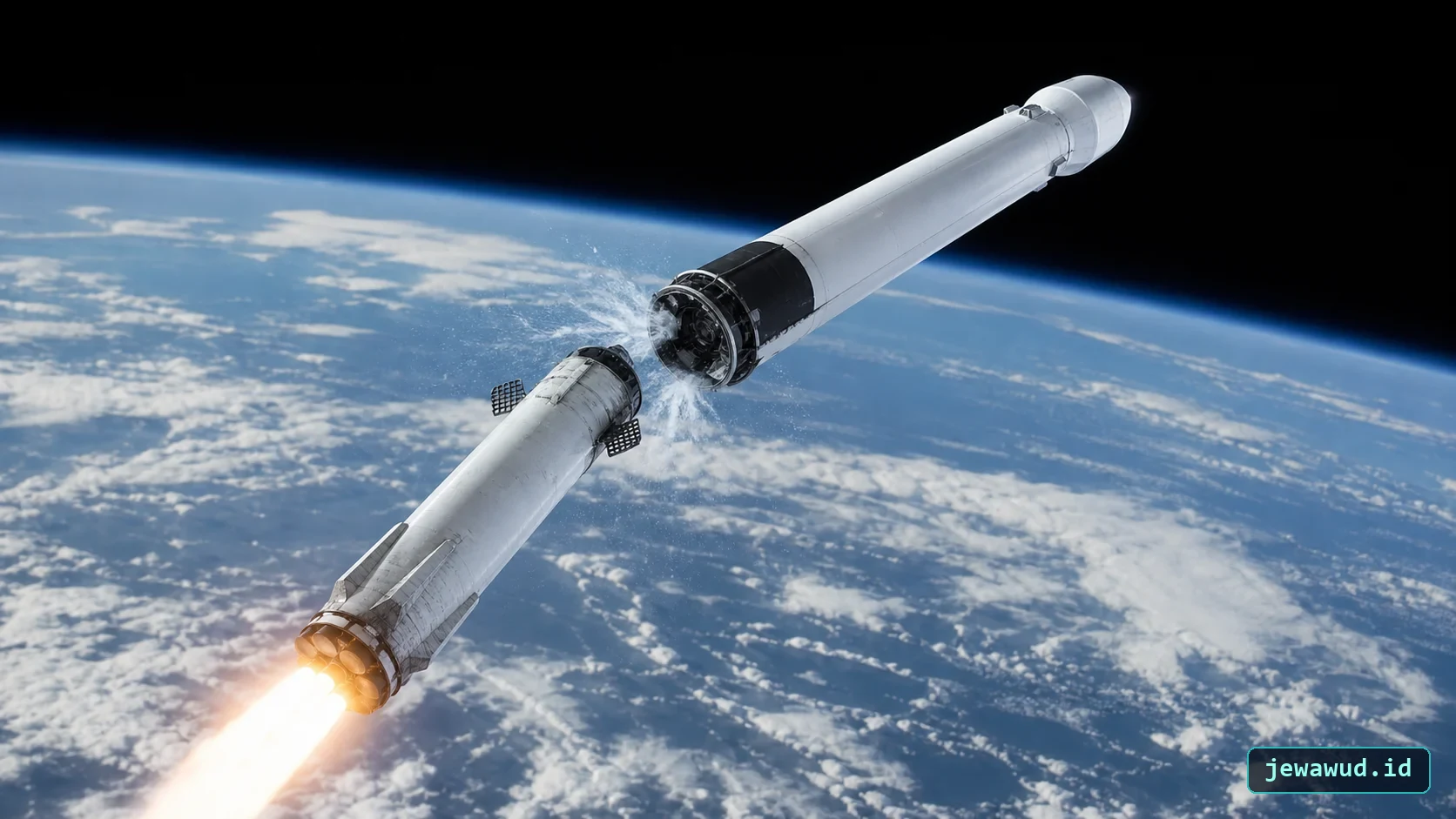
 Stage separation removes dead mass during ascent
01The Hardware You Stop Carrying
An empty propellant tank still has mass. So do its engine, plumbing and supporting structure. If an upper stage has to accelerate that hardware along with its own propellant and payload, it needs more energy for a job the discarded hardware no longer helps perform.
Staging removes that burden. NASA's practical rocketry guide describes the principle of discarding exhausted stages. Separation itself is not an enormous forward kick: its main performance benefit is that the following burn accelerates less mass.
Not everything thrown away is a rocket stage. A powered stage has propulsion; a payload fairing protects the payload, and payload deployment releases the spacecraft. All can change the mass being carried, but they serve different purposes.
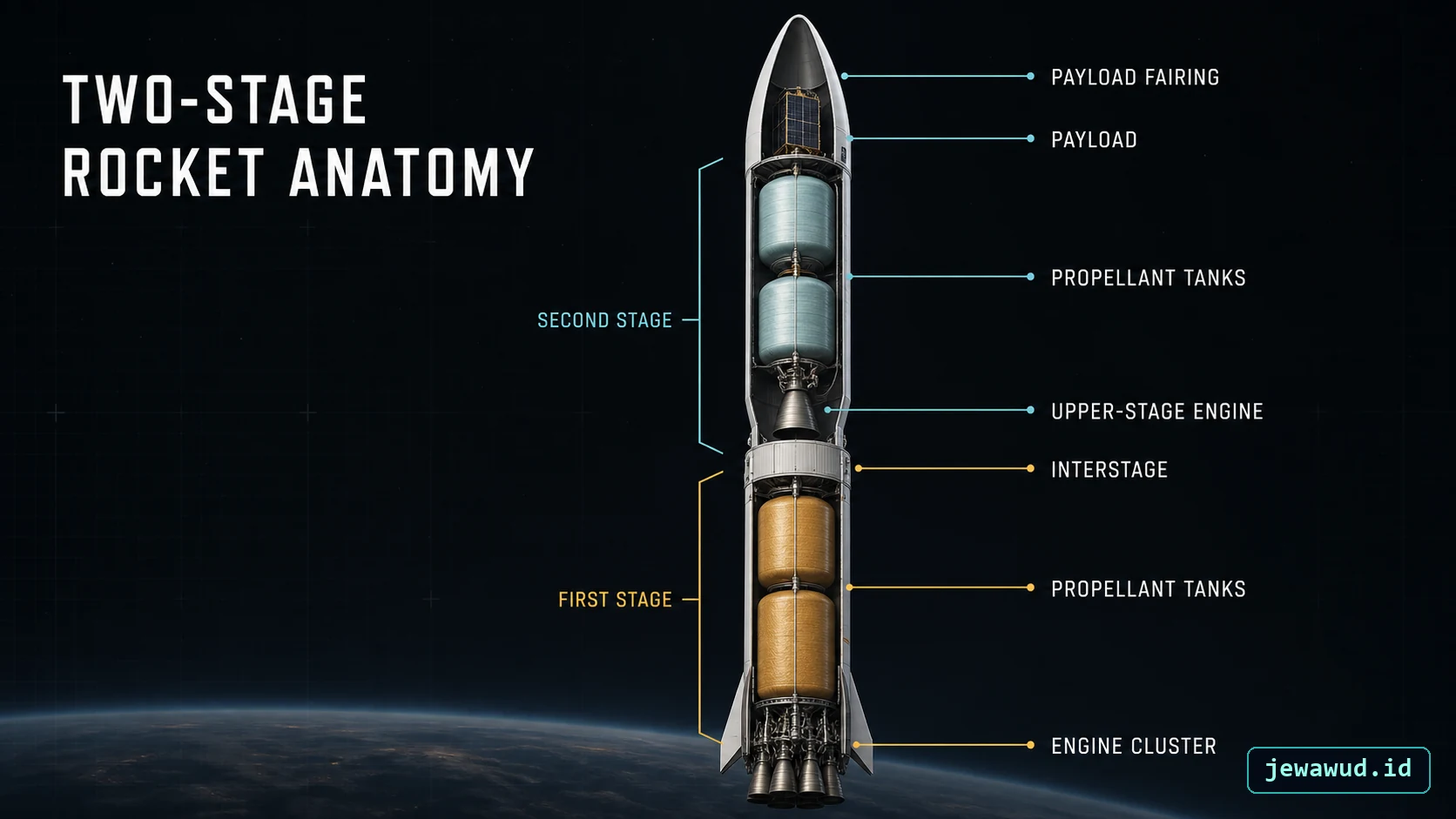 A launch vehicle carries engines and propellant in separate stages so empty structure can be discarded
02Count Everything Above The Firing Engine
For one ideal burn, delta-v = Isp g0 ln(m0/mf). Isp is specific impulse in seconds, g0 is 9.80665 m/s2, and m0 and mf are total vehicle masses immediately before and after that burn. Use consistent mass units so their ratio is dimensionless. NASA derives the ideal rocket equation from momentum conservation.
For a lower-stage burn, those masses include the entire upper stack, not just the lower-stage tanks. For the upper-stage burn, start a new calculation after separation. Dry hardware is still included until it is actually released; burning propellant and jettisoning hardware are different events.
Adding the ideal delta-v from each burn gives an ideal capability, not a predicted final speed above the ground. Gravity, aerodynamic drag, steering, pressure-dependent performance and propellant reserves are outside the simple example below.
03A 10-Tonne Example You Can Recalculate
Hypothetical vehicle, not Falcon 9 data: the first stage contains 6 tonnes of propellant and 1 tonne of dry hardware. Above it sits a 3-tonne stack: 2 tonnes of upper-stage propellant, 0.5 tonnes of upper-stage dry hardware and 0.5 tonnes of payload. Assume both engines have constant Isp of 300 seconds. The masses add to 10 tonnes at departure.
The first burn consumes 6 tonnes, so the vehicle goes from 10 to 4 tonnes. Its ideal contribution is 300 × 9.80665 × ln(10/4), or 2.696 km/s.
Release the 1-tonne empty first stage. The upper stack now starts at 3 tonnes and ends its burn at 1 tonne, including its remaining dry hardware and payload. Its contribution is 300 × 9.80665 × ln(3/1), or 3.232 km/s. Using unrounded values, the total is 5.928 km/s.
Now keep the spent first stage attached but change nothing else in this deliberately simplified comparison. The second burn becomes 4 to 2 tonnes, producing only 2.039 km/s. The total falls to 4.735 km/s. Discarding that one tonne adds about 1.193 km/s of ideal capability with the same propellant and payload.
The comparison isolates a mass-ratio effect; it does not propose a buildable vehicle or claim either version can reach orbit. In an ideal separation with negligible relative push, there is no instantaneous jump in the upper vehicle's speed. The advantage appears during its later burn.
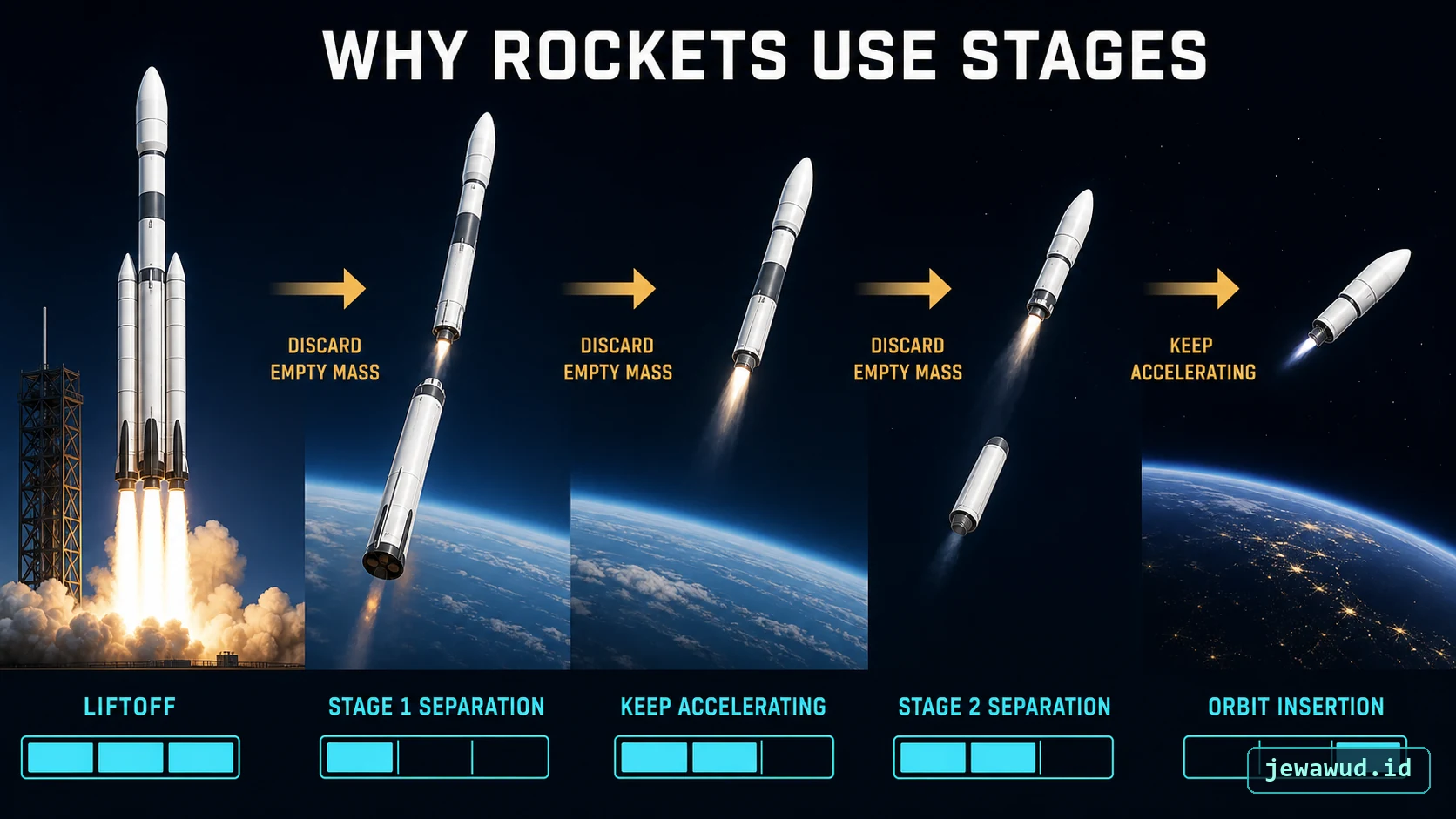 Each separation removes empty mass while the remaining stages continue accelerating toward orbital velocity
04Separation And Ignition Are Different Events
Watch for main engine cutoff, stage separation and second-stage ignition as separate milestones. In its Falcon 9 overview, SpaceX describes the second-stage engine igniting a few seconds after separation. A coast between visible engine plumes therefore does not by itself mean something has failed.
Do not turn that sequence into a rule for every rocket. Hot-staging architectures begin upper-stage operation before the lower stage has fully separated. The article's sequence illustration is a generic teaching view, not a timing diagram for all launch vehicles.
05Fairings, Recovery And The Payload
The fairing is discarded when the mission can tolerate the aerodynamic and thermal environment without it, not at one universal altitude. Removing it saves carried mass, but it does not add another powered stage. In launch footage, identify whether you are seeing fairing halves, a booster, or the actual payload before interpreting a separation.
Recovery adds a second objective: preserve the booster as well as deliver the payload. SpaceX describes Falcon 9 as a partially reusable two-stage vehicle. Landing hardware and any reserved recovery propellant must be accounted for in a realistic performance analysis; our fully consumed-propellant example has neither.
After the booster separates, its return trajectory and the upper stage's ascent are distinct flights. A successful booster landing is not the same event as a successful payload deployment. A launch timeline should be read as several milestones, not one finish line.
06Inspect A Stage Layout Before Watching A Launch
Open the Jewawud Rocket 3D Explorer and compare the assembled and exploded views. Identify the tanks and engines of each stage, then locate the payload and its protective structure. The model is useful for identifying components, not for measuring certified hardware dimensions.
On your next launch broadcast, ask three questions at each separation: what mass was released, which engine will accelerate the remaining stack, and where is the payload now? Return to the example above if a separation seems to create speed from nowhere. The mass bookkeeping, rather than the visible flash or gap, explains the performance gain.
Follow The Payload Through The Stack
Identify stage boundaries and the hardware left behind after separation.
Open Rocket 3D Explorer