 Orbital decay begins long before visible reentry
01Losing Energy, Not Falling Straight Down
A satellite in low Earth orbit moves through extremely thin air. Atmospheric drag takes energy out of its orbital motion. Over time, the orbit can shrink until the vehicle encounters much denser air and reenters. This long-term change is orbital decay; it is not the same as the normal rise and fall in altitude along an elliptical orbit.
Gravity has not suddenly switched on, and the satellite does not simply drop vertically. It was already in free fall while orbiting. Drag changes the path of that fall. For a slowly shrinking, nearly circular orbit, the characteristic orbital speed actually increases as the orbit gets lower, even though drag opposes motion relative to the atmosphere.
02Why Two Satellites At The Same Height Decay Differently
A useful starting point is a_drag = 0.5 rho Cd (A/m) v_rel2. Here rho is atmospheric density, Cd is drag coefficient, A is projected area, m is mass, and v_rel is speed relative to the air, not simply an inertial speed reading. This is NASA Glenn's drag equation divided by mass.
Consider two hypothetical objects with the same mass, shape-dependent coefficient and relative speed in the same air. If one exposes twice the area, it experiences twice the drag acceleration at that instant. Rotating or tumbling changes the exposed area, so orientation matters as well as size.
This comparison is not a lifetime calculator. Density changes along the orbit and over time. A single altitude and mass cannot tell you that a satellite has exactly a certain number of days left.
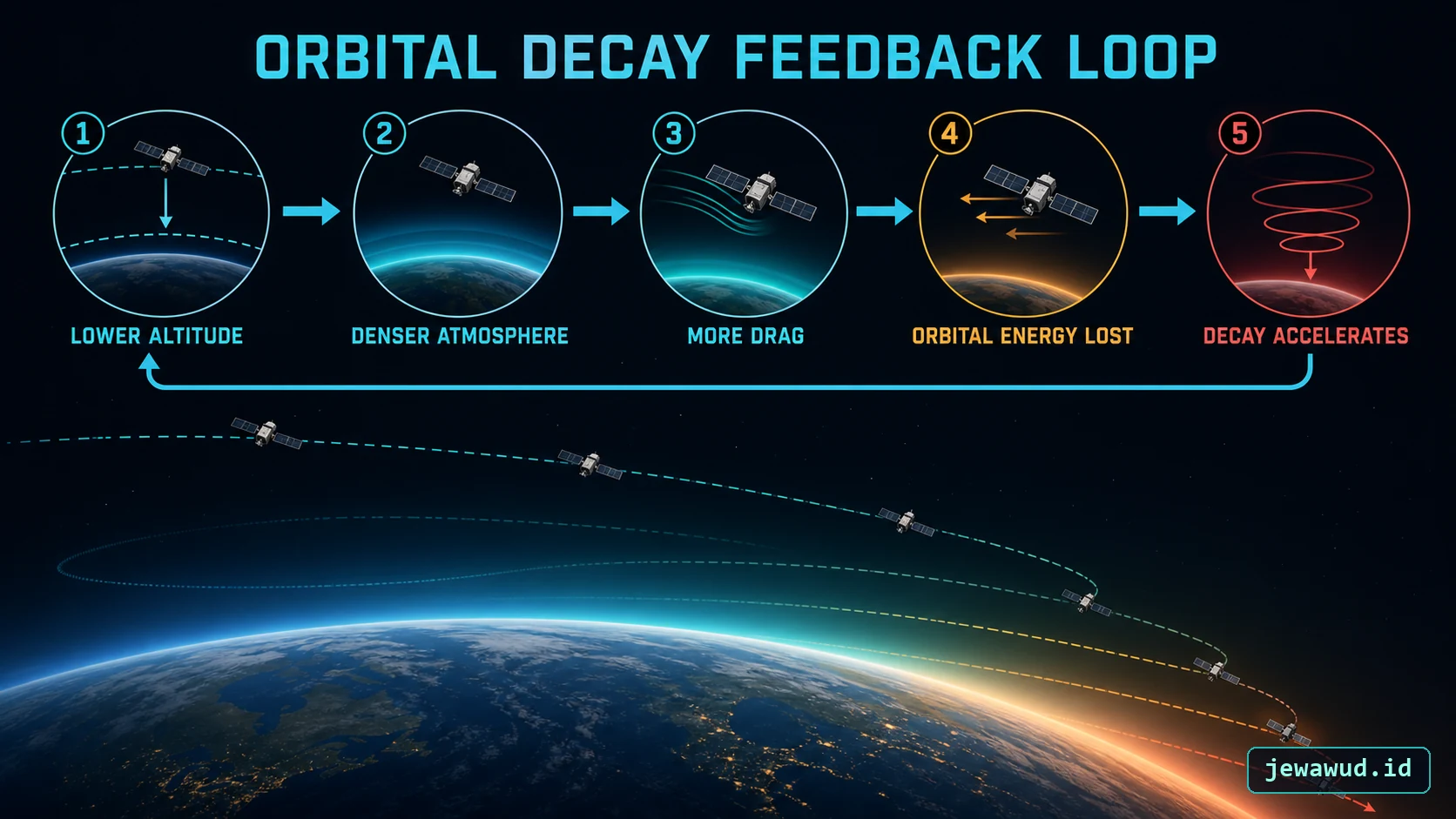 Lower altitude increases atmospheric drag, removes more energy, and makes the next descent happen faster
03A Falling Altitude Readout Is Not Enough Evidence
Suppose an undisturbed elliptical orbit ranges between 400 and 600 km. A tracker will show the satellite descending from apogee toward perigee every revolution, then climbing again. That repeating 200 km swing is geometry, not proof of decay.
To investigate long-term change, compare dated element sets for the same catalog object. Look at the evolution of perigee, apogee and semi-major axis rather than two instantaneous positions. Keep the TLE epoch with each record: downloading an old element set today does not make it a measurement from today.
A sustained decrease can be consistent with drag, but deliberate deorbit burns, reboosts and changes in fitted tracking data also affect the trend. The orbit history needs mission context before you attribute every change to the atmosphere.
04Why Reentry Forecasts Keep Moving
Solar activity can heat and expand the upper atmosphere, changing the density a low satellite encounters. The same spacecraft can then experience more drag without changing its hardware. ESA describes this connection in its account of solar activity during the Aeolus reentry campaign.
Uncertain future density and changing orientation make an uncontrolled reentry time difficult to forecast. At orbital speeds, even a modest timing uncertainty covers a large ground distance. ESA's reentry overview explains why tracking updates are important and why a predicted window is not a precise impact location.
A globe marker extrapolated from a TLE is therefore not a debris warning. Once the object has reentered, continuing the old orbit mathematically does not mean a spacecraft is still following it.
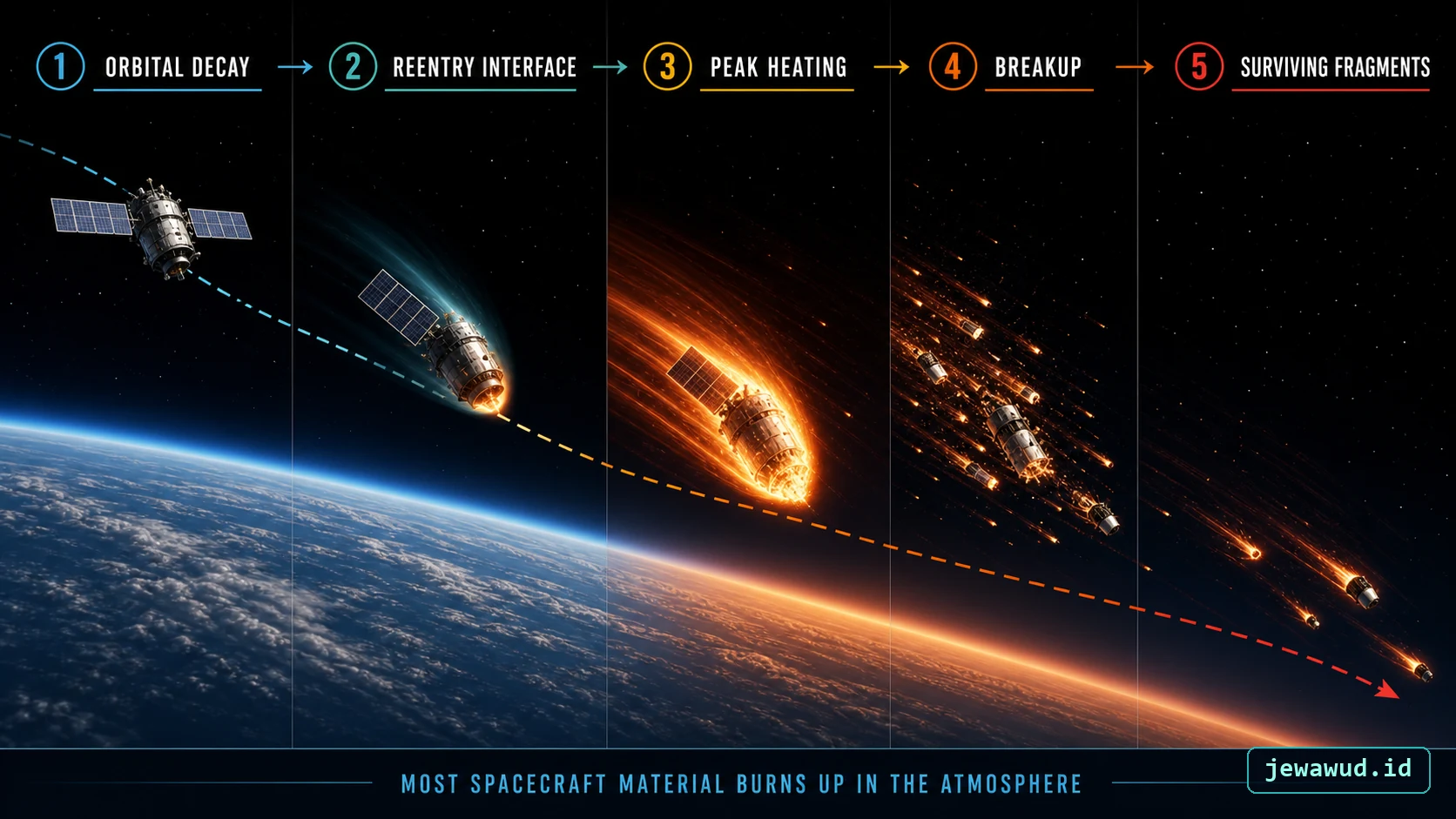 Reentry follows a long shallow orbital path before heating, breakup, and possible fragment survival
05Aeolus: An Assisted Reentry, Not A Landing
Historical case: ESA reports that Aeolus reentered on 28 July 2023 above Antarctica. Controllers used its remaining fuel in a sequence of maneuvers to lower the orbit from about 320 km to 120 km and constrain the final ground tracks. Read the mission's reentry report for the outcome.
ESA calls this an assisted reentry. It should not be confused with an uncontrolled natural decay, a fully targeted controlled reentry, or a spacecraft landing intact. Those labels describe different degrees of control and different mission objectives. A dramatic illustration of a burning vehicle cannot establish which case occurred.
06Read The Catalog As A Dated Record
In the Jewawud Satellite Index, start with object identity, source dates and any documented reentry status. Then inspect the epoch associated with the orbit. A historical profile can remain useful after a satellite is gone, but its last orbital snapshot is not a current location.
For an object still in orbit, use Jewawud Orbital Tracker (JOT) to explore the geometry, and the catalog to interpret the record. If the element set is stale or the object is recorded as reentered, do not treat a propagated dot as evidence of continued flight.
The useful question is not just "how low is it?" It is "what changed between dated observations, what else could explain that change, and how certain is the source?" That distinction separates an educational orbit display from a reentry prediction service.
Check The Epoch Before The Orbit
Compare a satellite's identity, dated orbit and documented status.
Open Satellite Index