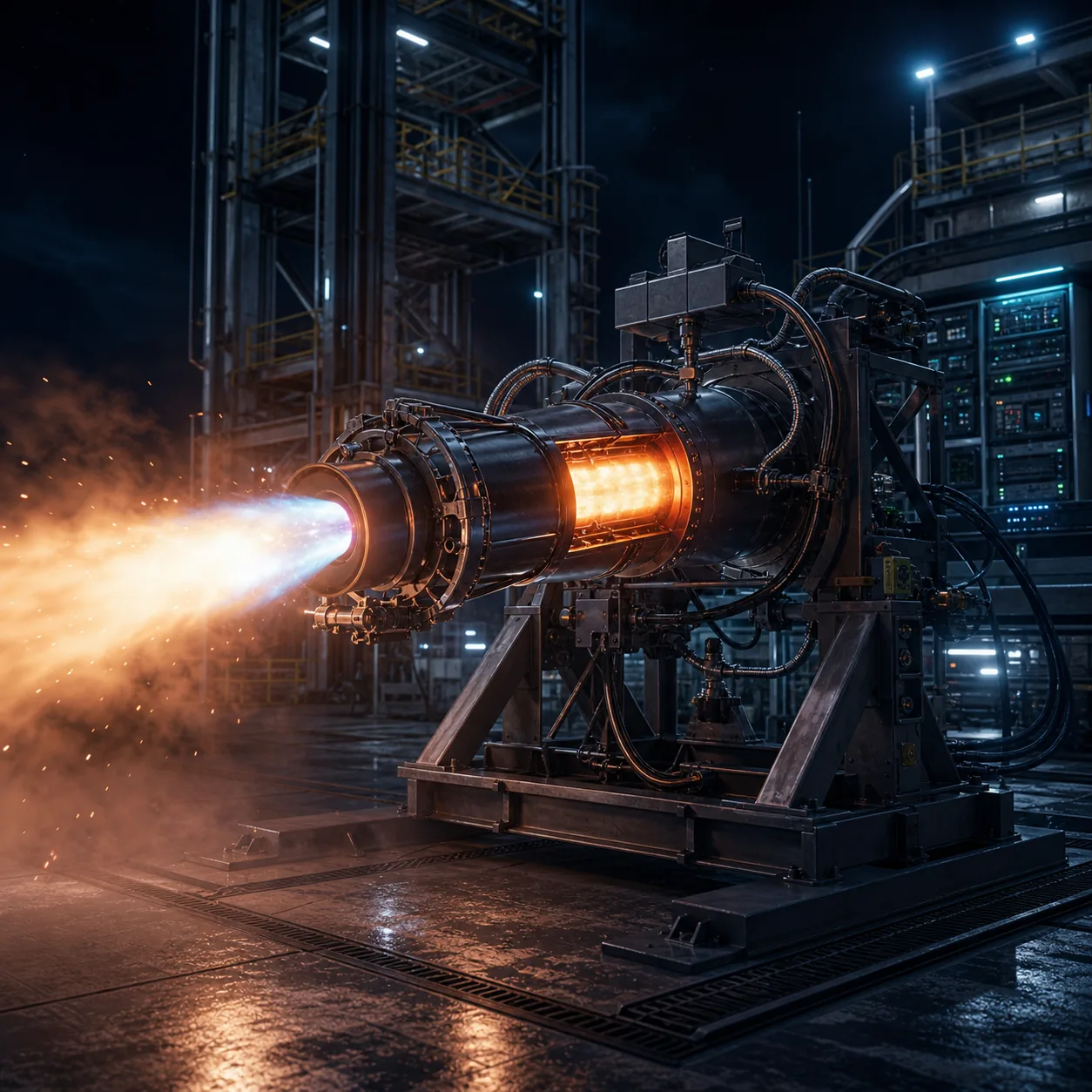
 Conceptual visualization of IGNIS 500 N-class hybrid motor static-fire testing
01Mission Objective
IGNIS is a subscale 500 N-class hybrid rocket motor test article. Its purpose is not to be a launch vehicle engine yet; it is a controlled research platform for learning how grain geometry, ignition behavior, nozzle heating, oxidizer feed stability, and data acquisition behave under repeatable static-fire conditions.
The 500 N thrust class is intentional. It is large enough to produce meaningful combustion and structural data, but still small enough for disciplined iteration, safer test operations, and practical hardware turnaround inside an independent research environment.
02System Architecture
Motor Assembly
Modular chamber, injector, grain cartridge, and nozzle interfaces allow each subsystem to be revised between tests without redesigning the entire motor. The architecture is built for learning speed, not one-off spectacle.
Fuel Grain Research
Interchangeable polymer-based grain cartridges make it possible to compare port geometry, regression behavior, ignition consistency, and post-burn residue across controlled test campaigns.
Oxidizer Feed
N2O is treated as a test variable, not just a propellant. Feed pressure, flow stability, valve timing, and injector response are measured so thrust data can be tied back to actual system behavior.
Instrumentation
The test stand centers on thrust, pressure, flow, and thermal measurement. Every firing is designed to produce data that can be compared, repeated, and used to improve the next configuration.
03Key Specs
04Test Campaign
Cold Flow
Validate oxidizer plumbing, valve timing, leak checks, and sensor calibration before introducing ignition or combustion loads.
Ignition Characterization
Measure ignition delay, pressure rise, and startup repeatability across grain and injector configurations.
Short Static Fire
Run low-duration firings to validate thrust stand response, chamber pressure stability, and safe shutdown behavior.
Full-Duration Burn
Execute the nominal burn window only after the feed system, ignition transient, thermal behavior, and emergency procedures are proven.
05Safety & Research Framing
IGNIS is framed as a static-fire research platform. Test operations prioritize remote actuation, procedural checklists, conservative pressure margins, instrumentation sanity checks, and post-test inspection before performance chasing.
The most valuable output is not a dramatic plume. It is trustworthy data: thrust curves, pressure traces, injector response, nozzle heating, and repeatability between tests.
06Roadmap
"IGNIS is not about making the biggest fire. It is about making combustion measurable, repeatable, and useful."
The near-term goal is a dependable 500 N-class data engine. The long-term roadmap is to use those lessons to inform a larger flight-weight motor, where thrust vectoring, lighter structures, and integrated guidance can be explored with far more confidence.
NEXTExplore Next
Interested in IGNIS?
We are looking for propulsion engineers, materials researchers, instrumentation specialists, and careful test operators.