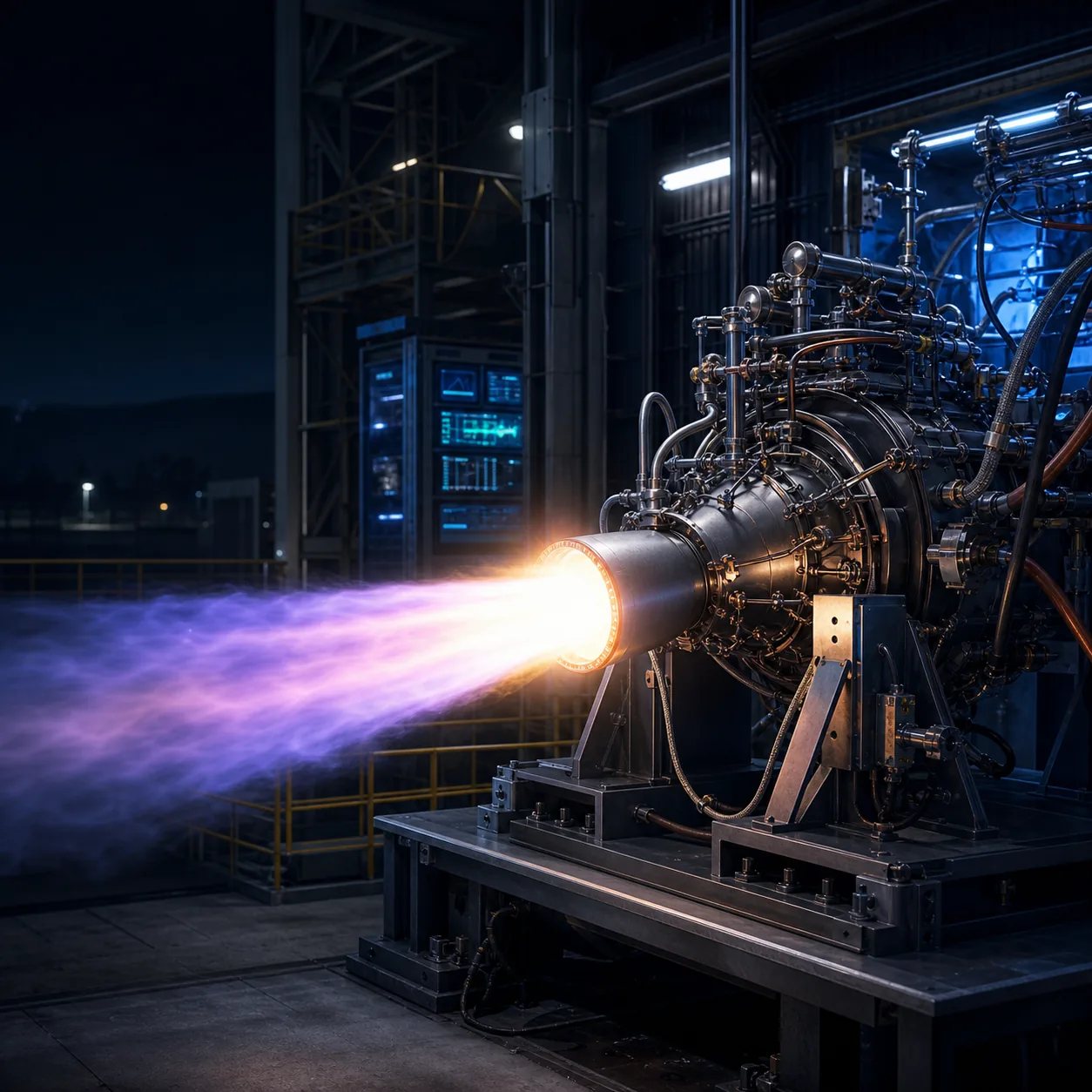
 Conceptual visualization of hybrid rocket motor static fire testing
01 Overview
Rocket propulsion is where dreams meet thermodynamics. At Jewawud Propulsion Laboratory, this isn't just a research topic — it's in our name. Our propulsion program covers the full spectrum of launch technology: from chemical hybrid rocket motors that we design, 3D-print, and static-fire test, to electric propulsion concepts for deep-space missions that may one day carry payloads beyond Earth orbit.
We believe that access to space shouldn't be limited to governments and billionaires. Our goal is to develop modular, cost-effective propulsion technologies that lower the barrier to entry for sounding rockets, suborbital research platforms, and eventually, orbital launch vehicles. Every engine we design starts with first-principles physics and ends with hot fire.
02 Research Objective
The propulsion program is focused on repeatable, instrumented motor development rather than one-off demonstrations. Each design is expected to produce useful pressure, thrust, temperature, and flow data that can improve the next firing cycle.
The immediate target is a safer subscale hybrid motor workflow: predictable ignition, controlled chamber pressure, stable thrust, recoverable test hardware, and data acquisition good enough to support real engineering decisions.
03 Key Research Areas
Hybrid Rocket Motors
Our primary propulsion research focuses on hybrid rocket motors using nitrous oxide (N₂O) as the oxidizer and custom-formulated 3D-printed fuel grains. Hybrid motors offer the safety of solid rockets with the controllability of liquids — you can throttle them, shut them down, and restart them. We're currently targeting 500N sustained thrust with our IGNIS test platform.
Electric Propulsion
For missions beyond the atmosphere, chemical propulsion gives way to electric. We're investigating Hall-effect thrusters and pulsed plasma thrusters (PPTs) for small satellite station-keeping and deep-space trajectory correction. High specific impulse, low thrust — the slow and steady approach to interplanetary travel.
Computational Fluid Dynamics (CFD)
Before anything burns, it gets simulated. We use OpenFOAM and ANSYS Fluent to model combustion chamber flow fields, nozzle expansion dynamics, and thermal management systems. Our CFD pipeline includes mesh generation, turbulence modeling (k-ε and LES), and conjugate heat transfer analysis — because surprising the nozzle with unexpected thermal loads is a bad day for everyone.
Thrust Optimization & Nozzle Design
We apply computational optimization techniques — including genetic algorithms and topology optimization — to design nozzle contours that maximize thrust coefficient while minimizing weight. Our regeneratively-cooled nozzle designs use the propellant itself as coolant, routing it through channels in the nozzle wall before injection into the combustion chamber.
04 Methodology & Toolchain
05 Related Projects
06 Research Vision
"Every rocket is a controlled explosion with ambitions. We're just trying to make the ambitions bigger and the explosions more controlled."
Our long-term propulsion roadmap leads from static test stands to sounding rockets, and eventually to suborbital research vehicles. We believe Indonesia's geographic position near the equator makes it an ideal launch site — and we intend to prove it. Our ultimate goal isn't just to build engines; it's to build a space industry, one burn at a time.
07 Validation Roadmap
Validation begins with cold-flow checks, sensor calibration, ignition tests, and short-duration static fires before moving toward longer burns. Key metrics include chamber pressure stability, thrust curve smoothness, regression-rate consistency, nozzle erosion, and shutdown behavior.
The next milestone is to connect IGNIS test data back into CFD and guidance models, so propulsion, simulation, and control can improve as one integrated research loop.
NEXTExplore Next
Interested in our propulsion research?
We're always looking for collaborators, contributors, and curious minds.