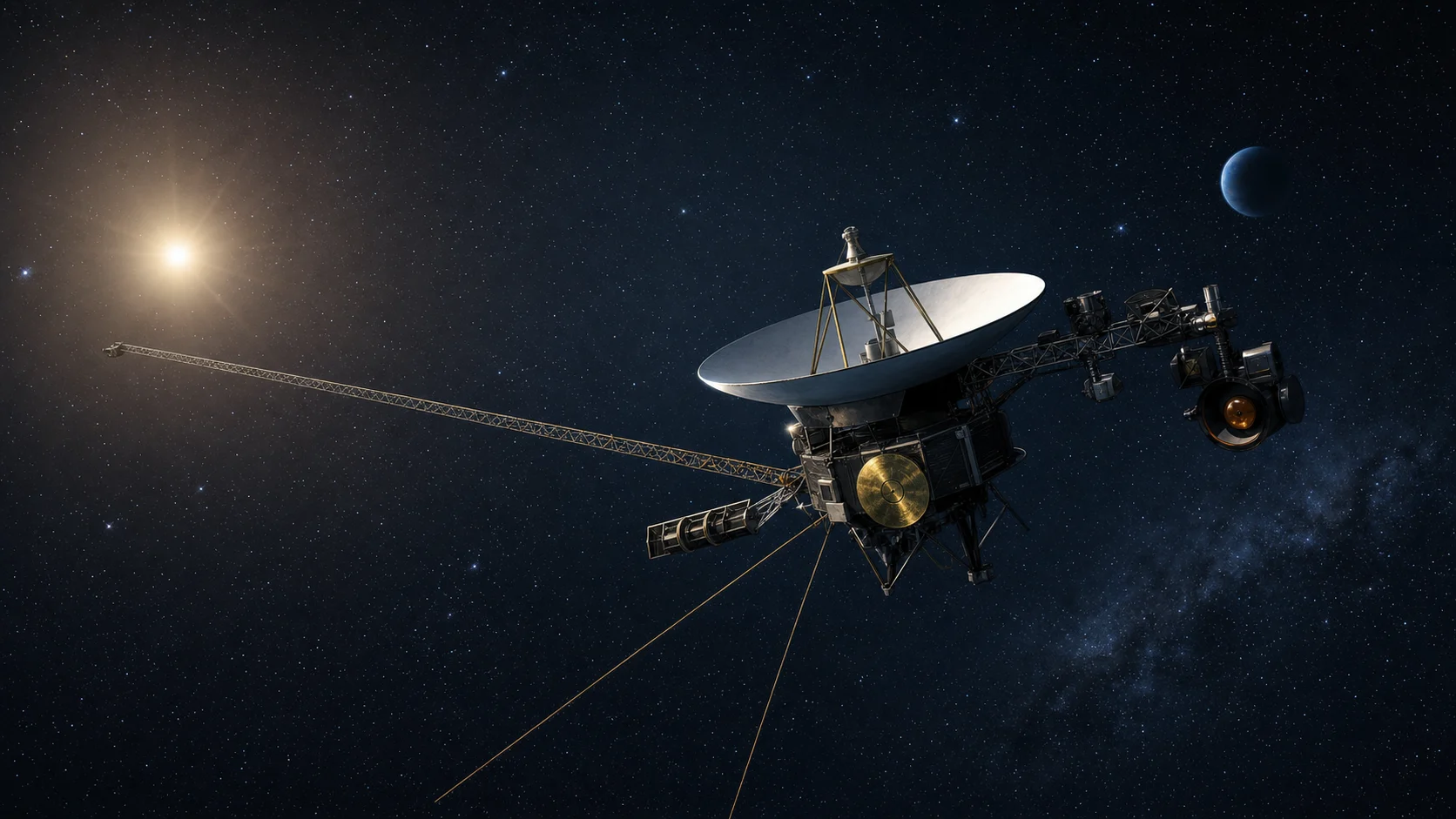
 Voyager's recognizable shape is driven by communication, power, and science needs
01A Spacecraft Built Around Communication
The most recognizable feature of Voyager is its large high-gain antenna. Deep space missions need tight, carefully pointed communication links because signal strength drops dramatically with distance.
The antenna is not decoration. It is the spacecraft's lifeline, letting mission controllers send commands and receive scientific data across enormous distances.
02Instruments On Booms
Voyager uses long booms to separate sensitive instruments from the spacecraft body. This helps reduce interference and gives sensors a cleaner view of the surrounding environment.
The spacecraft architecture looks unusual because it is not shaped for atmosphere, passengers, or landing. It is shaped for measurement, pointing, power, and communication.
03Why It Still Inspires
Voyager's long life makes it a reference point for reliability. The mission shows how careful engineering, simple operating modes, and conservative spacecraft design can keep producing science far beyond the original tour.
For interactive 3D learning, Voyager is also a great model because each visible component has a clear reason to exist.
04Power Far From The Sun
Solar panels are common on many Earth-orbiting spacecraft, but Voyager traveled too far from the Sun for solar power to remain practical. Instead, it relied on radioisotope power systems that could keep producing electricity in the cold outer solar system.
This power choice shaped the mission. A deep-space spacecraft must manage energy carefully, turn instruments on and off strategically, and keep the most important systems alive for as long as possible. Longevity is not an accident; it is a design philosophy.
When viewing a Voyager model, the spacecraft body, antenna, booms, and power system should be understood as one survival architecture. Every visible element exists because distance makes everything harder.
05Gravity Assist Mission Design
Voyager's planetary tour was possible because mission planners used gravity assists. Instead of carrying all the propellant needed to visit multiple outer planets directly, the spacecraft used close planetary flybys to reshape its trajectory.
A gravity assist does not mean the planet magically pulls the spacecraft for free in every reference frame. It means the spacecraft exchanges energy and direction through a carefully planned flyby, using the planet's motion around the Sun as part of the mission design.
This is one reason launch timing mattered so much. Deep-space missions are not only about spacecraft hardware; they are also about celestial geometry and choosing the right window.
06How To Read The Spacecraft Shape
The high-gain antenna points back toward Earth. The long magnetometer boom keeps sensitive measurements away from spacecraft interference. Science instruments are arranged so they can observe targets during flybys. The compact central bus holds key electronics and structural systems.
Unlike a launch vehicle, Voyager does not need a streamlined body. It never flies through a thick atmosphere after deployment. That freedom creates the open, skeletal shape that makes deep-space probes look so different from rockets and crew capsules.
In an educational 3D viewer, rotating Voyager helps make this logic visible. The spacecraft is not symmetrical decoration; it is a layout of communication, power, measurement, and pointing priorities.
07The High-Gain Antenna As The Centerpiece
Voyager's dish antenna dominates the spacecraft visually because communication dominates deep-space mission design. The farther a spacecraft travels, the weaker its radio signal becomes by the time it reaches Earth. A large, accurately pointed antenna helps keep that link usable.
This is why attitude control matters so much. If the antenna is not pointed correctly, the spacecraft may still be alive but unable to communicate effectively. Deep-space operations are often a careful balance between pointing instruments at targets, pointing antennas at Earth, and conserving power.
For 3D learning, the dish gives users an immediate orientation clue. If you know which way the antenna faces, you can begin to understand how the spacecraft relates to Earth even when it is far beyond the inner planets.
08Science Instruments And Mission Priorities
Voyager carried instruments designed to study planets, moons, magnetic fields, particles, plasma waves, and the space environment. The spacecraft had to support many kinds of measurements without the luxury of repair, refueling, or hardware replacement.
This makes instrument placement important. Some sensors need clear fields of view. Others need distance from spacecraft-generated interference. The spacecraft body is therefore not just a box with parts attached; it is an arrangement of measurement priorities.
When inspecting a Voyager model, it helps to ask what each protruding structure is trying to avoid or observe. Booms, scan platforms, antennas, and instrument housings are all clues about the physical needs of deep-space science.
09Why Voyager Did Not Need Aerodynamics
Rockets and aircraft must care deeply about aerodynamic shape because they move through dense atmosphere. Voyager, once deployed, operated in space. It did not need wings, a smooth fuselage, or a heat-shielded exterior for atmospheric flight.
That freedom explains the spacecraft's open architecture. The shape follows communication, power, thermal control, instrument placement, and pointing needs. It looks fragile compared with a rocket, but it is optimized for a different environment.
This distinction is useful for comparing models in Rocket 3D Explorer. Saturn V and Soyuz are launch systems shaped by ascent. Voyager is a robotic spacecraft shaped by deep-space operations.
10Longevity As A Design Lesson
Voyager's long mission life is not only inspiring; it is educational. Long-duration spacecraft need conservative engineering, redundancy where possible, careful power budgeting, and operating modes that can adapt as hardware ages.
Over decades, available power decreases, instruments are turned off, and mission priorities change. A spacecraft that survives that long must be understandable to teams far removed from its original launch era. Documentation, command discipline, and robust systems become part of the spacecraft's real architecture.
For students and enthusiasts, Voyager shows that space exploration is not only about launch day. The mission continues through operations, data management, communication strategy, and the slow art of keeping a machine useful across time.
11Voyager In A 3D Explorer
A 3D Voyager page should make component purpose easy to understand. The antenna should be visually prominent. The booms should be readable as measurement structures rather than random rods. The central body should feel like the bus that supports power, control, and instruments.
Callouts should avoid crowding because Voyager has many small features. A good interaction pattern is to let users select one component at a time, bring attention to it, and explain why it exists. This is more effective than placing every label on the canvas at once.
When the 3D page and article reinforce each other, users can learn the spacecraft by rotating it, selecting components, then reading the deeper mission context behind those shapes.
12Common Voyager Misunderstandings
One misunderstanding is assuming Voyager is shaped like a satellite bus used near Earth. It is not. Its long booms, large antenna, and compact central body reflect a deep-space mission with different constraints.
Another misunderstanding is treating the Golden Record as the main technical purpose of the spacecraft. The record is culturally iconic, but Voyager's primary mission was scientific exploration. Its instruments, trajectory, antenna, and power system are the engineering story.
A final misunderstanding is thinking distance alone makes Voyager important. Distance is impressive, but the deeper lesson is endurance: a spacecraft designed for a planetary tour became a long-lived messenger from the outer solar system and beyond.
13What Voyager Teaches Modern Missions
Modern spacecraft are more capable, but Voyager still teaches a durable lesson: design around the mission environment. Deep space punishes weak communication margins, careless power planning, and unnecessary complexity. The farther the spacecraft travels, the more every watt, bit, command, and pointing decision matters.
Voyager also shows why public mission storytelling matters. A spacecraft can be technically brilliant, but people remember it more deeply when they can understand its shape, purpose, and journey. An interactive model helps preserve that understanding by turning a distant spacecraft into something users can inspect directly.
For Jewawud, Voyager is a strong bridge between 3D exploration and educational writing. The model attracts curiosity; the article explains why the machine looks the way it does. That pairing makes deep-space engineering feel less distant, memorable, and more inspectable.
FAQQuick Questions
Why does Voyager have such a large dish? The antenna is needed to communicate across deep-space distances where signals become extremely weak.
Why are instruments placed on long booms? Booms reduce interference from the spacecraft body and improve measurement quality.
Is Voyager still useful to study? Yes. Its design clearly shows the engineering priorities of long-duration robotic exploration.
Inspect Voyager
Open the Voyager model in Rocket 3D Explorer to study the antenna, booms, and spacecraft body in 3D.
Open Voyager 3D Page