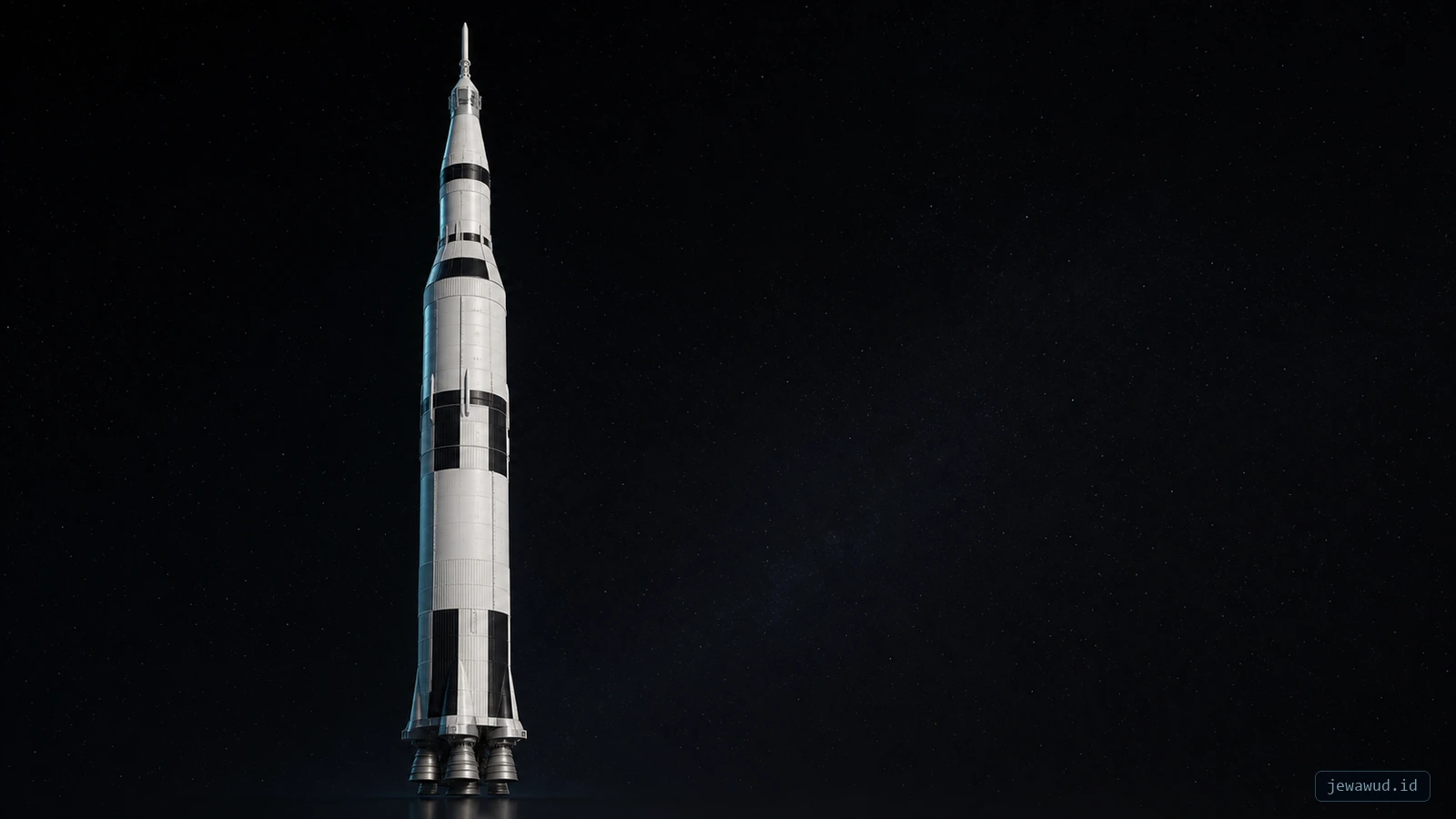
 Staging lets a rocket drop empty mass and keep accelerating
01Why Stages Exist
Large rockets stage because empty tanks and engines become dead weight. By dropping spent hardware, the remaining vehicle becomes lighter and can accelerate more efficiently.
Saturn V used this principle at extreme scale. Each stage had a different job, from brute-force liftoff to the precise burn that sent Apollo toward the Moon.
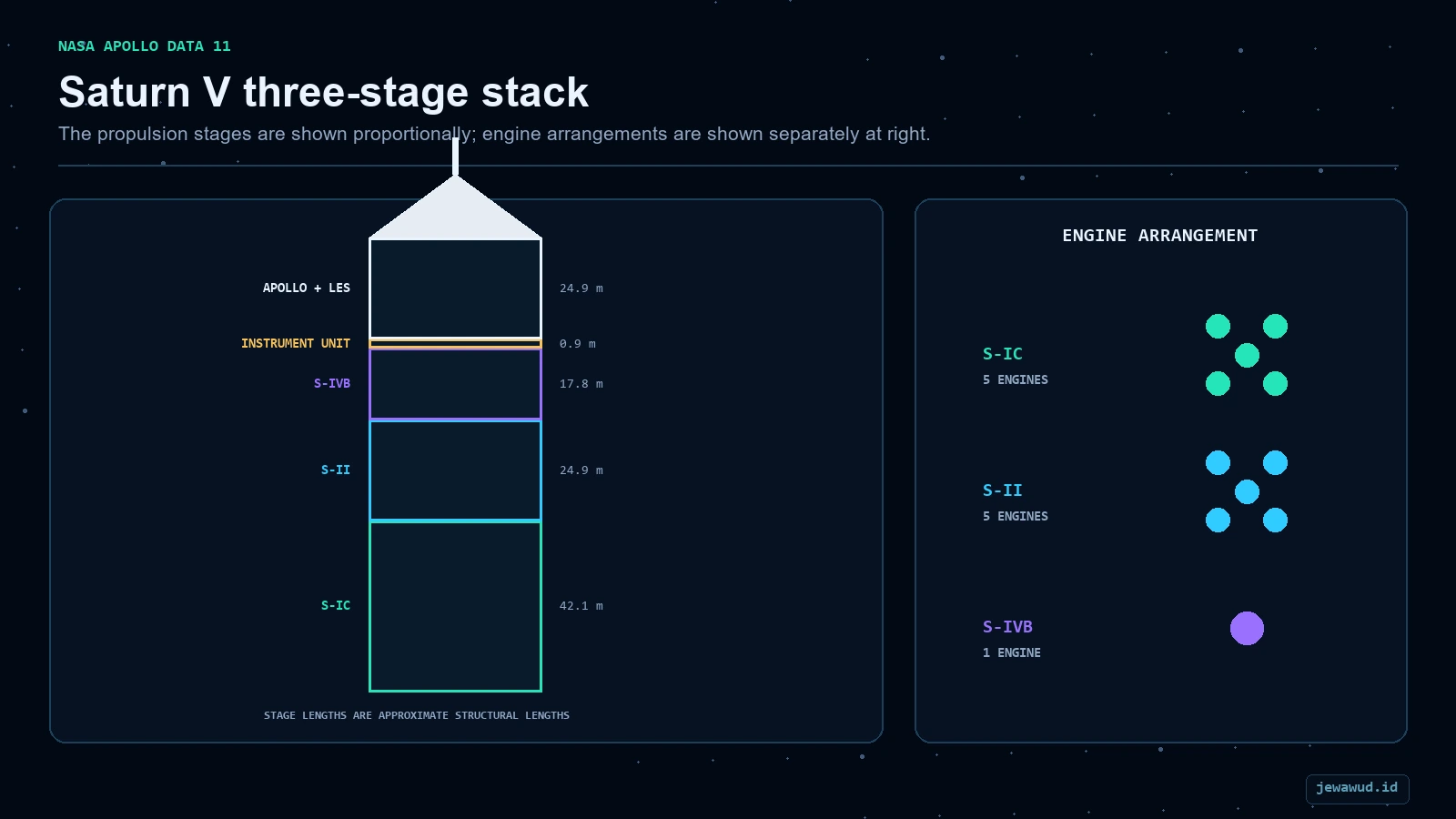 The S-IC, S-II, and S-IVB stages divide the 110.6-meter launch vehicle into distinct propulsion jobs
02The Three Main Stages
The first stage lifted the vehicle from the pad and pushed it through the dense lower atmosphere. The second stage continued the climb and added major velocity. The third stage helped complete Earth orbit and later performed translunar injection.
Above the stages sat the Apollo spacecraft system: command module, service module, lunar module adapter, and lunar module. The rocket and spacecraft worked as one mission architecture.
03Why It Still Matters
Saturn V remains useful to study because its layout makes rocket staging easy to understand. You can see the logic physically: large thrust at the bottom, precision mission hardware at the top, and staged mass removal between them.
Modern heavy-lift rockets use different engines and materials, but the core staging logic still echoes through launch vehicle design.
04First Stage: Leaving Earth
The first stage had the most visually dramatic job: lift the full vehicle from the pad while it was heaviest. At liftoff, the rocket was carrying nearly all of its propellant, all upper stages, and the Apollo spacecraft. This phase required enormous thrust and strong structure.
The first stage did not need to reach orbit by itself. Its role was to push the vehicle through the early ascent, build speed, and hand the remaining stack to the next stage after its propellant was spent. Once empty, it became mass that the mission no longer needed.
05Second And Third Stage Logic
The second stage continued the climb after the thickest atmosphere was behind the rocket. It added velocity and altitude while carrying a much lighter stack than the first stage had to move. This is where staging really shows its value: the vehicle becomes progressively more efficient because it is no longer dragging empty hardware upward.
The third stage had a dual role in Apollo missions. It helped place the spacecraft into Earth parking orbit, then restarted for the translunar injection burn. That second job was mission-defining: it turned an Earth-orbiting spacecraft into one headed toward the Moon.
Because the third stage interacted so closely with mission timing, it is useful to think of Saturn V not only as a launch vehicle but as the first part of a larger lunar transportation system.
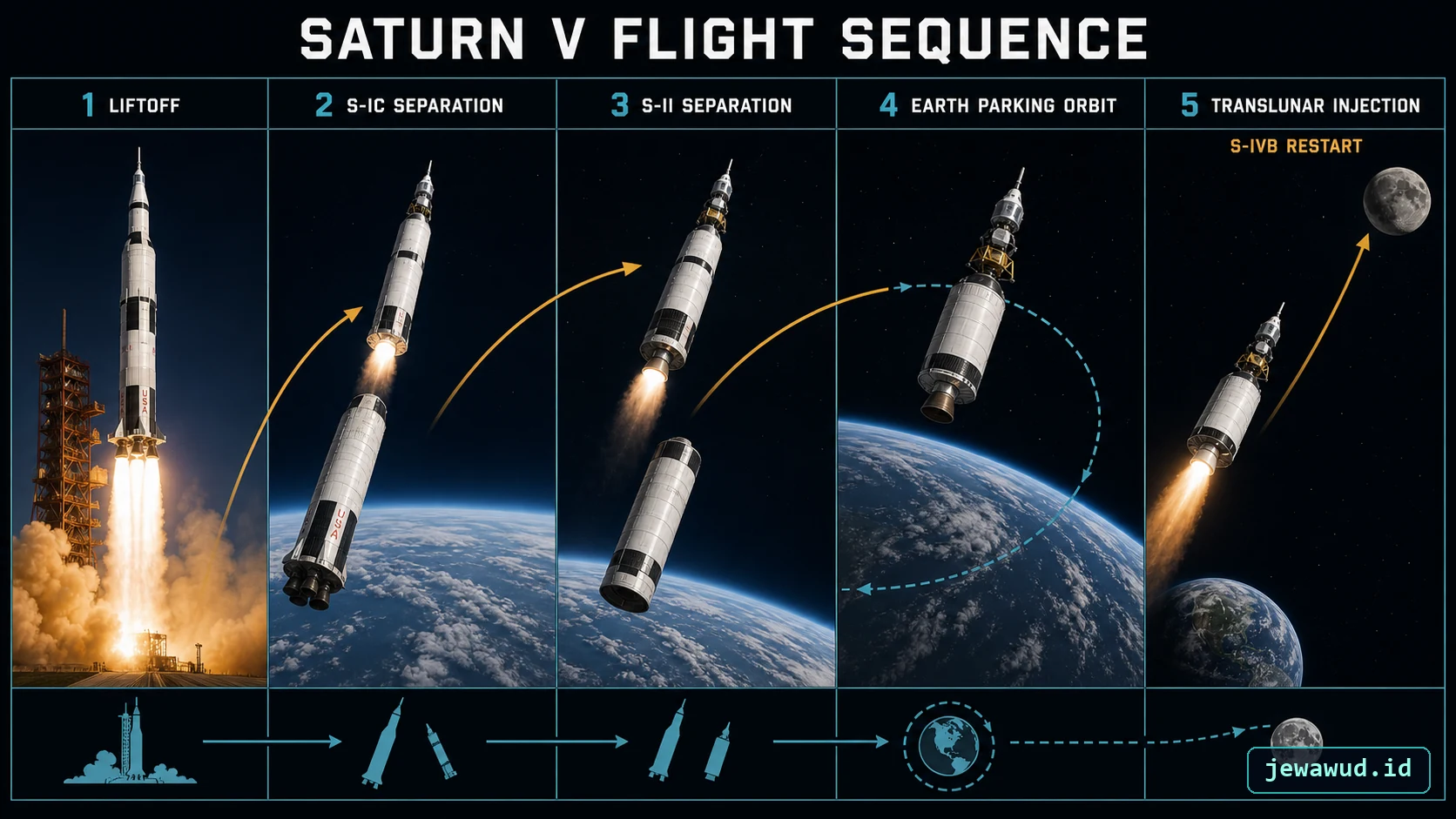 The third stage first reaches parking orbit and later restarts to send Apollo toward the Moon
06How To Read An Exploded View
An exploded view of Saturn V should preserve order. Bottom-to-top reading matters: first stage, interstage, second stage, interstage, third stage, instrument unit, spacecraft adapter, lunar module, service module, command module, and launch escape tower for early ascent.
If a model spreads the parts too far apart, the rocket can become harder to understand. If it keeps them too close, the stage boundaries disappear. The best educational view shows separation while still making the stack sequence obvious.
For a learner, the key question is simple: what does this part do after the previous part is no longer useful? Saturn V is a clean answer to that question, repeated across an enormous machine.
07The Instrument Unit
Saturn V was not guided by muscle alone. Near the top of the launch vehicle sat the instrument unit, a ring-shaped section that contained guidance, navigation, and control systems. It helped the rocket know where it was, where it needed to go, and how to steer during ascent.
This matters because a huge rocket is only useful if it can fly a precise trajectory. The engines provide force, but the guidance system coordinates that force into a mission path. Without guidance, staging would simply create a sequence of powerful but uncontrolled events.
In a 3D educational model, the instrument unit can be easy to miss because it is not as dramatic as an engine or spacecraft. But conceptually, it is one of the key parts that turns Saturn V from a tower of propellant into a guided launch system.
08Apollo Spacecraft Above The Rocket
Above the launch vehicle stages sat the Apollo spacecraft stack. This included the command module where astronauts returned to Earth, the service module that supported propulsion and life-support functions, and the lunar module stored behind panels for the journey to the Moon.
That upper spacecraft stack is important because Saturn V was not the entire mission. It was the transportation system that gave Apollo enough energy to leave Earth orbit. Once the major rocket stages finished their work, the spacecraft had to perform navigation, docking, lunar operations, and return.
For learners, separating "rocket" from "spacecraft" helps. The Saturn V stages explain how the mission escaped Earth's surface and reached the trans-lunar path. The Apollo spacecraft explains how humans actually traveled, landed, survived, and returned.
09Mass, Propellant, And The Rocket Equation
Staging exists because rockets fight mass. Most of a large launch vehicle is propellant, and once that propellant is burned, the empty tanks and engines become a burden. Dropping empty stages improves the remaining vehicle's ability to accelerate.
This is connected to the rocket equation, which shows how velocity change depends on exhaust velocity and the ratio between full and empty mass. You do not need to solve the equation to understand the lesson: carrying less dead mass makes the next phase easier.
Saturn V is a dramatic physical demonstration of this principle. The vehicle starts as an enormous tower, then becomes progressively smaller as it completes each job. That shrinking is not failure. It is the plan.
10Why The Third Stage Was Special
The third stage was not simply the last piece of a climb. For Apollo lunar missions, it helped establish Earth parking orbit and then performed the burn that sent the spacecraft toward the Moon. That restart capability made it central to the mission profile.
Earth parking orbit gave crews and controllers time to verify spacecraft systems before committing to the translunar injection burn. This sequence reduced risk and gave the mission a structured transition from launch to lunar travel.
When studying Saturn V in 3D, it is useful to see the third stage as a bridge. Below it are the heavy ascent stages. Above it is the Apollo spacecraft. Its job connects Earth launch to deep-space trajectory.
11Common Saturn V Misreadings
A common mistake is thinking every visible boundary is just a paint pattern. Saturn V's black-and-white roll markings are visually famous, but the important structural boundaries are the stage and interstage separations. A good diagram or model should help users distinguish paint, structure, and functional separation.
Another mistake is treating the lunar module as if it sat exposed at the top like a modern payload. During launch, it was housed inside the spacecraft adapter below the command and service module. The adapter panels protected and enclosed it until the spacecraft performed the extraction sequence later in the mission.
These details matter because Saturn V was more than a tall rocket. It was a carefully sequenced mission architecture, and each piece only makes full sense when placed in that sequence.
12Why Saturn V Is Still A Teaching Standard
Saturn V remains one of the clearest examples of staged launch architecture because its mission objective was easy to understand and extremely demanding: lift humans from Earth and send them toward the Moon. The vehicle's size was not arbitrary. It was a response to payload mass, mission energy, safety margin, and the limits of chemical propulsion.
For students, the rocket is a compact lesson in systems engineering. Propulsion, structure, guidance, staging, crew safety, and mission timing all appear in one stack. A good 3D model can turn that stack into a readable sequence instead of a museum silhouette.
That is why Saturn V belongs in an explorer app. It gives users a familiar object, then rewards closer inspection with real engineering logic. Even a simple rotation can reveal how launch architecture is built from connected mission decisions.
FAQQuick Questions
Did Saturn V fly to the Moon as one piece? No. Stages were discarded as they finished their jobs, while the Apollo spacecraft continued onward.
Why did the third stage restart? Apollo missions used it after Earth orbit to perform the translunar injection burn.
Why is staging efficient? It removes empty tanks and engines so the remaining vehicle has less mass to accelerate.
Inspect Saturn V
Use Rocket 3D Explorer to inspect the Saturn V model and compare its major rocket elements interactively.
Open Saturn V 3D Page