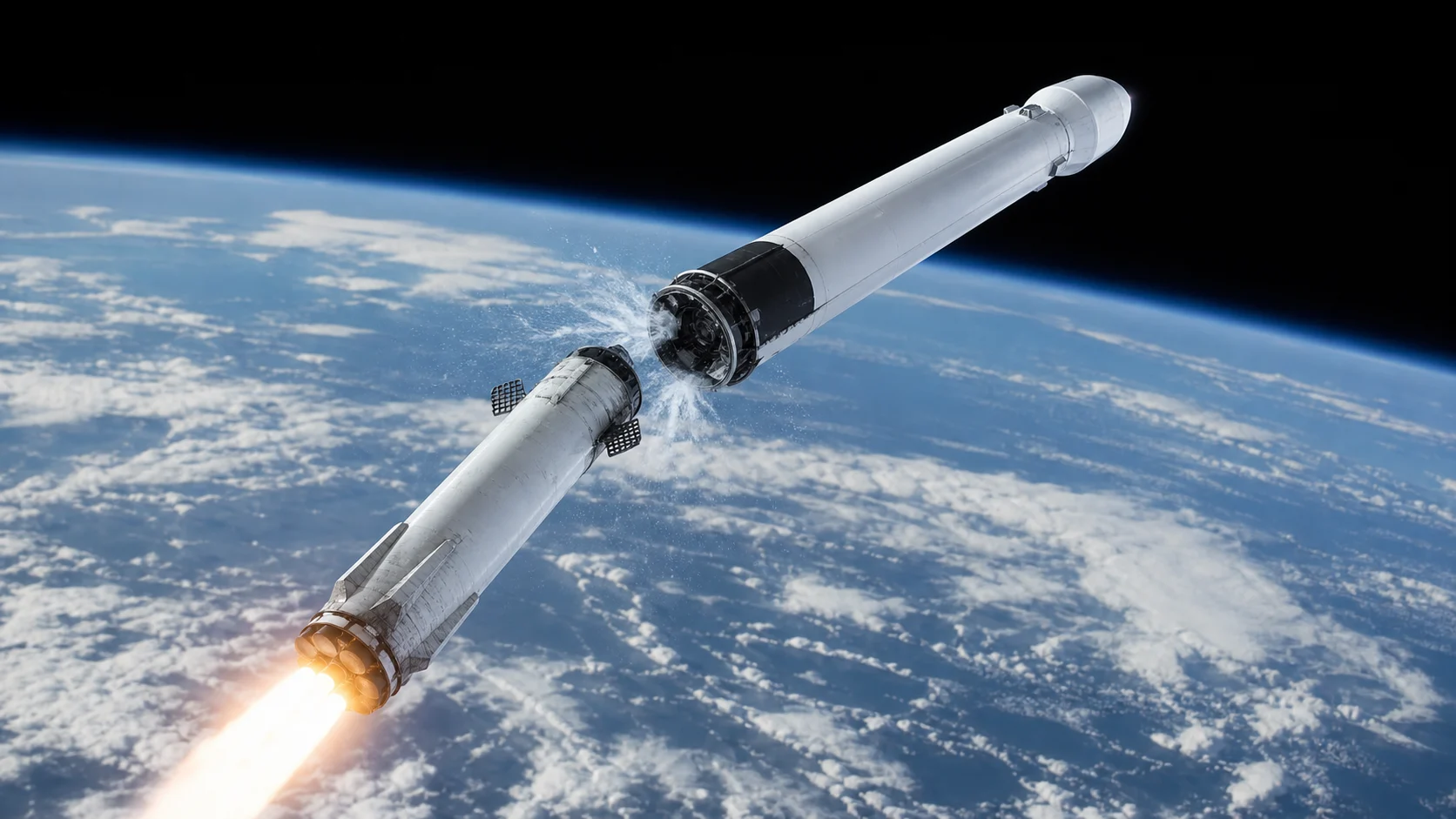
 Stage separation removes dead mass during ascent
01Why Staging Exists
A rocket must carry propellant, engines, tanks, structure, avionics, payload, and often fairings or boosters. As propellant burns, empty tanks and engines become dead weight. Staging solves that problem by discarding hardware after it has done its job.
The idea is brutally practical. A launch vehicle is a mass-management machine. The first stage lifts the heavy stack through dense atmosphere and early gravity losses. Later stages are smaller because they no longer need to carry the empty first-stage tanks and engines. This lets the upper vehicle accelerate more efficiently toward orbital speed.
02Mass Fraction
Mass fraction is the relationship between propellant mass and the total mass of a stage. Rockets are sensitive to mass because every kilogram carried upward must be accelerated. A good stage carries a lot of propellant relative to its dry structure, but it still needs to be strong enough to survive loads, vibration, pressure, and heating.
Staging helps because each stage has a fresh mass fraction after separation. Instead of dragging empty tanks all the way to orbit, the vehicle sheds them. The second stage begins its work with a cleaner ratio of useful propellant to total mass. That is why staging is not cosmetic; it is central to reaching orbit.
03First Stage Job
The first stage handles liftoff, max dynamic pressure, and the early climb. It needs high thrust because the rocket must accelerate while fighting gravity and pushing through dense air. A reusable first stage may also carry extra systems: grid fins, landing legs, restart capability, and propellant reserve for recovery.
In a visual simulator, this stage should feel powerful and heavy. Liftoff should not look like the rocket instantly teleports to high altitude. Early altitude changes are measured against the launch tower, cloud deck, and ground scale. The first few seconds matter because they establish trust in the simulation.
04Stage Separation
Stage separation occurs after the lower stage is no longer useful for ascent. The engines shut down, mechanical connections release, and the upper stage moves away before ignition. Timing is critical. The vehicle must avoid collision, maintain attitude, and start the next engine under suitable conditions.
Different rockets use different separation systems. Some use pneumatic pushers, springs, ullage motors, or hot staging. The visual moment may last only seconds, but the engineering behind it is serious. A clean separation protects the payload and preserves the mission.
05Fairing Jettison
The payload fairing protects the spacecraft from aerodynamic loads and heating during early ascent. Once the rocket is above enough atmosphere, the fairing becomes unnecessary mass. It is then jettisoned so the upper stage does not carry it all the way to orbit.
Fairing timing should make physical sense. If a simulator drops the fairing too low, the payload would be exposed to excessive aerodynamic conditions. If it drops too late, the vehicle wastes performance. The exact event depends on trajectory and vehicle design, but the principle is always the same: keep protection only as long as protection is needed.
06Upper Stage Job
The upper stage finishes the work of reaching orbital velocity. It may perform one long burn, multiple burns, or coast phases depending on the mission. A low Earth orbit mission may require one insertion burn. A geostationary transfer mission may involve a coast and a later burn to reach the correct apogee.
Upper stages often operate in near vacuum, so their engines can use larger nozzles optimized for space. They do not need the same sea-level thrust as the first stage, but they need precision. The payload's final orbit depends on timing, attitude, guidance, and engine performance.
07Reusable Staging
Reusable rockets complicate staging in a fascinating way. The first stage separates and then performs burns to return, reenter, and land. This requires extra propellant and hardware, which reduces expendable performance but can lower cost if reuse works reliably.
In a 3D simulator, reuse should be treated as a separate mission phase. The booster is no longer part of the payload ascent after separation. It has its own guidance, attitude, engine restarts, grid fin control, and landing sequence. Showing that separation clearly helps users understand why launch videos often track two vehicles at once.
08What A Good Simulator Should Show
A rocket staging simulator needs more than event labels. The vehicle should accelerate gradually from the pad, clear the tower at a believable time, pass through max Q, and then stage only after the first stage has done meaningful work. If the altitude reads tens of kilometers while the rocket is still beside the tower, the user immediately knows something is wrong. Visual scale and telemetry must agree.
Stage separation should also change the mass and behavior of the vehicle. The upper stage should not look like the same rocket simply continuing upward. It should be smaller, lighter, and operating in thinner atmosphere or near vacuum. If the first stage is reusable, it should become a separate object with its own path. The camera may choose to follow the payload, the booster, or a cinematic split, but the simulation should know that two vehicles now exist.
Fairing jettison deserves the same care. It should happen after the vehicle is above the dense atmosphere. The fairing halves should separate cleanly, drift away, and no longer be counted as payload mass. Payload deployment should happen after orbital insertion or at the correct mission phase, not while the rocket is still fighting through the lower atmosphere. These details are what make a launch simulator feel educational instead of arcade-like.
Telemetry should use readable event names: liftoff, max Q, main engine cutoff, stage separation, second engine start, fairing jettison, orbit insertion, payload deploy. Each event should connect to a visible change. A label without a visual consequence feels empty. A visual effect without correct timing feels fake. The sweet spot is when the user sees the event, reads the data, and understands why it happened.
09Staging Across Rocket Families
Different rockets solve staging in different ways. Saturn V used three large stages for the Moon mission sequence. Soyuz uses strap-on boosters around a core stage, creating the famous Korolev Cross during booster separation. Falcon 9 uses a reusable first stage and an expendable upper stage for many missions. The details vary, but the logic is the same: use each piece when it is useful, then stop carrying it.
This is why a 3D explorer and an article index should support each other. The article teaches the general principle. The model shows the hardware. When a user compares Saturn V, Soyuz, and Falcon-style staging, they begin to see rocket design as a set of tradeoffs rather than a collection of cool shapes.
10Reading A Launch Timeline
A launch timeline is easiest to read as a chain of mass, atmosphere, and speed decisions. Liftoff proves thrust is greater than weight. Max Q marks the hardest aerodynamic pressure region. Main engine cutoff ends the lower stage's job. Separation removes empty hardware. Second stage ignition continues the climb toward orbital velocity. Fairing jettison removes protection once the air is thin enough. Payload deploy happens only when the mission has reached the correct target conditions.
When those events are placed in a simulator, the user should be able to pause and explain the reason for each one. If the reason is clear, the timeline becomes a lesson. If the event is just a flashing label, it becomes noise. That is why staging articles matter: they give the visual events a mechanical backbone.
The same logic helps readers judge launch videos. They can ask what was dropped, why it was dropped, what engine is now firing, and whether the mission is still climbing, coasting, or circularizing. That habit turns rocket footage from spectacle into a readable engineering sequence, and it makes every separation event easier to understand.
FAQQuick Questions
Why not build one giant stage? Carrying empty tanks and engines to orbit wastes performance. Staging removes dead mass.
Is fairing jettison a stage? It is not a propulsive stage, but it is a mass-shedding event during ascent.
Can a first stage reach orbit? Usually not alone. It is optimized for early ascent, not final orbital insertion.
Explore Rocket Hardware
Open the 3D explorer and compare stage layouts across launch vehicles and spacecraft.
Open Rocket 3D Explorer