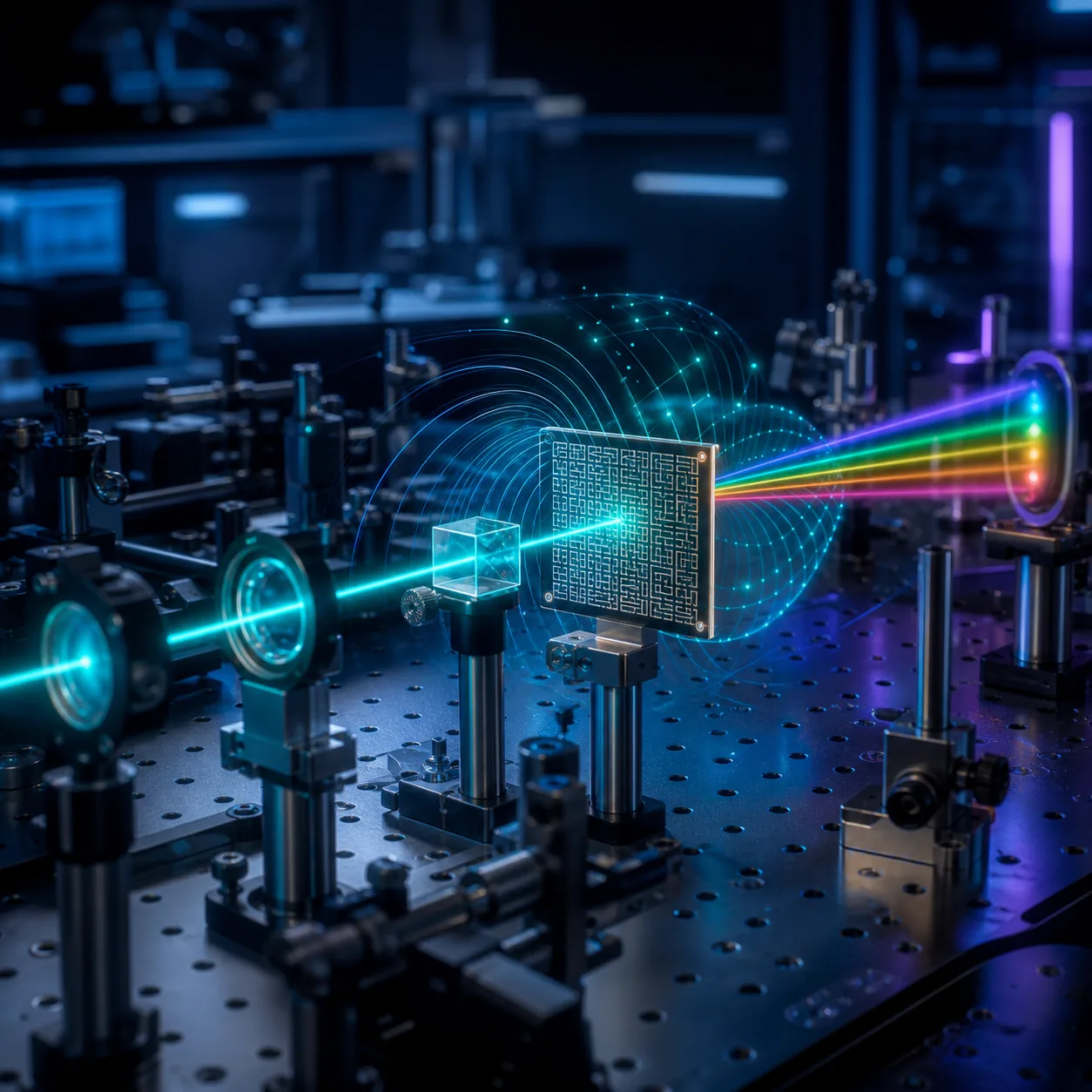
 Conceptual visualization of photonic metamaterial light manipulation
01 Overview
Light is the fastest messenger in the universe, and at JPL, we're teaching it new tricks. Our Advanced Optics research program explores the fundamental physics of electromagnetic wave propagation and applies it to build systems that can see the invisible, communicate at the speed of light, and manipulate photons at scales that were science fiction a decade ago.
We operate at the intersection of classical optics and modern nanophotonics — designing materials with electromagnetic properties that don't exist in nature and building optical systems that adapt in real time to changing environments. From satellite communication links to astronomical imaging, our optics research pushes the boundaries of what light can do.
02 Research Objective
The objective is to turn optical surfaces and sensor front-ends into programmable systems: components that can redirect, filter, focus, or interpret light based on mission conditions rather than fixed hardware assumptions.
Our near-term focus is practical photonics for sensing and communication, with measurable improvements in beam control, spectral selectivity, wavefront correction, and low-light signal recovery.
03 Key Research Areas
Photonic Metamaterials
We design and simulate sub-wavelength structures that exhibit exotic electromagnetic properties — negative refractive indices, perfect absorption, and electromagnetic cloaking at specific frequency bands. Using COMSOL Multiphysics and custom FDTD solvers, we engineer materials that control light in ways natural materials simply can't.
Adaptive Optical Systems
Atmospheric turbulence, thermal distortion, and mechanical vibration all degrade optical performance. Our adaptive optics research develops real-time wavefront correction systems using deformable mirrors, Shack-Hartmann sensors, and AI-driven predictive algorithms that anticipate and compensate for distortions before they happen.
Laser Systems & Free-Space Optical Communication
We research laser beam propagation through turbulent atmospheres, designing systems for high-bandwidth, low-latency optical data links. Our work spans from ground-to-air communication to potential future satellite laser crosslinks — replacing heavy RF equipment with lightweight, high-throughput photonic alternatives.
Optical Sensor Design
We develop custom optical sensors for applications ranging from environmental monitoring to industrial quality control. Our sensor designs integrate advanced spectral filtering, polarimetric analysis, and machine-learning-based signal processing to extract maximum information from minimum photons.
04 Methodology & Toolchain
05 Related Projects
06 Research Vision
"Light carries the universe's information at its ultimate speed limit. Our job is to learn how to read it — all of it — and then write back in the same language."
We envision a future where optical systems are as programmable as software — where surfaces can be reprogrammed to redirect, filter, and amplify light on demand. Our research into metamaterials and adaptive optics is laying the groundwork for a world where the boundary between optics and computing dissolves entirely.
07 Validation Roadmap
Validation starts in simulation, using electromagnetic and ray-tracing models to narrow candidate designs before bench testing. The main metrics are insertion loss, beam steering range, phase-control resolution, optical efficiency, and repeatability under thermal drift.
The next milestone is a PRISM-aligned prototype that can demonstrate electronically tunable surface behavior and feed clean optical data into the NOVA perception pipeline.
NEXTExplore Next
Interested in our optics research?
We're always looking for collaborators, contributors, and curious minds.