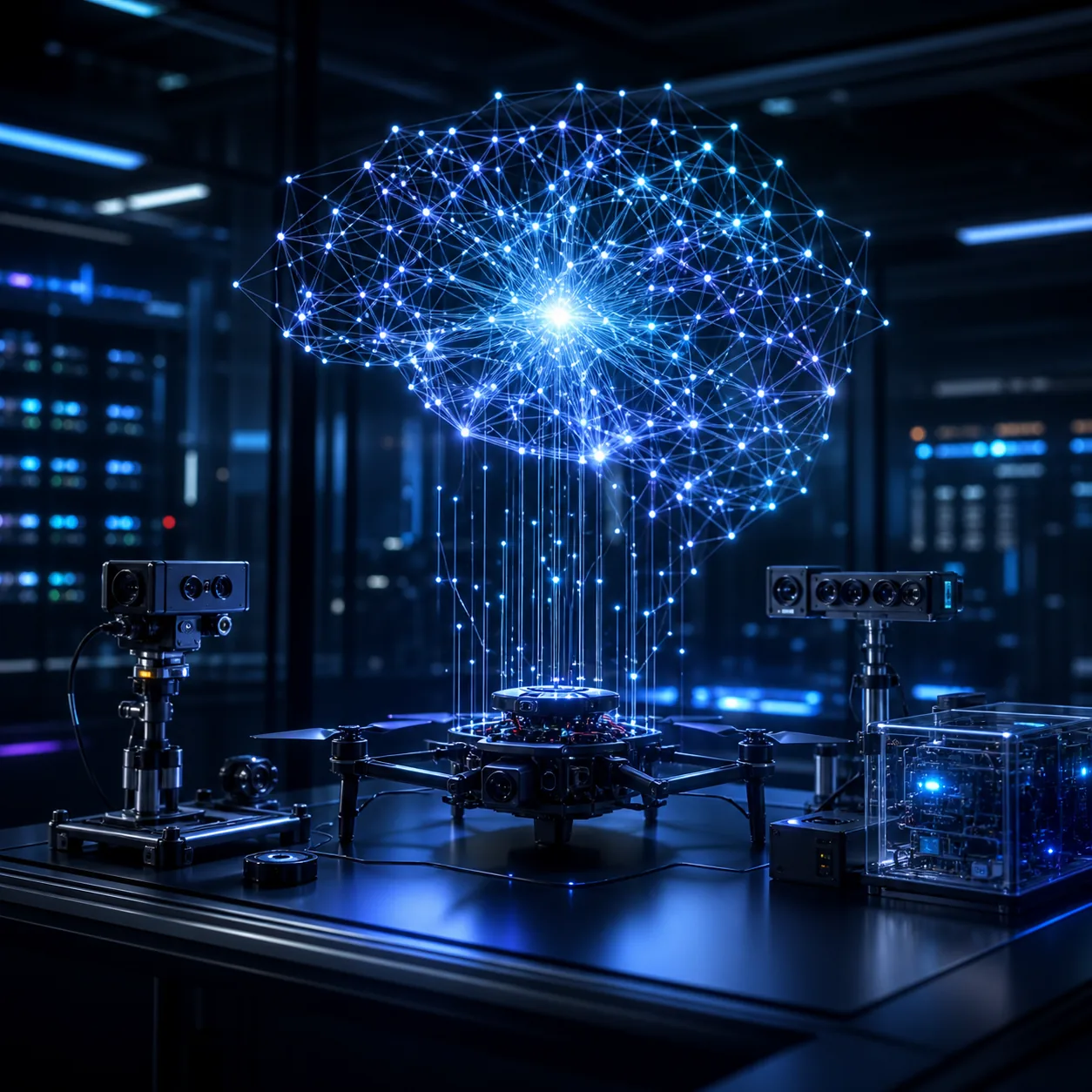
 Conceptual visualization of JPL's neural architecture research
01 Overview
At Jewawud Propulsion Laboratory, artificial intelligence isn't just a buzzword we throw around in grant proposals — it's the neural backbone of nearly everything we build. Our AI research program is designed from the ground up to create systems that perceive, reason, and act in real-world environments where milliseconds matter and failure isn't an option.
We approach AI not as a standalone discipline, but as a connective tissue between our optics and propulsion research. Our neural networks don't just classify images; they interpret multi-spectral sensor data to guide autonomous vehicles through GPS-denied environments. Our reinforcement learning agents don't just play games; they optimize rocket trajectories in real time.
02 Research Objective
The immediate objective of this program is to build perception and control models that can run reliably on edge hardware, explain their confidence, and remain useful when sensor input becomes noisy, incomplete, or delayed.
Our benchmark target is practical autonomy: low-latency inference, stable behavior under uncertainty, and repeatable simulation-to-hardware transfer for vision, navigation, and rocket guidance experiments.
03 Key Research Areas
Deep Learning & Neural Architecture Design
We design custom neural network architectures optimized for resource-constrained environments. Our work spans convolutional networks for real-time object detection, transformer-based models for sequence prediction, and neural ODEs for continuous-time dynamical system modeling. Every architecture is designed with deployment in mind — because a model that can't run on edge hardware is just an expensive spreadsheet.
Computer Vision & Sensor Fusion
Our vision systems go beyond standard RGB. We work with multi-spectral imaging, LIDAR point clouds, and infrared data — fusing them into unified scene representations that work in smoke, darkness, and adverse weather. Applications range from autonomous UAV navigation to industrial defect inspection.
Reinforcement Learning for Control
We train RL agents using Proximal Policy Optimization (PPO), Soft Actor-Critic (SAC), and custom reward shaping to solve control problems in propulsion and navigation. Our agents learn optimal thrust vectoring, fuel management, and trajectory planning — all in high-fidelity simulation before ever touching real hardware.
Generative AI & Design Optimization
We leverage generative adversarial networks (GANs) and diffusion models to explore vast design spaces. Whether it's generating novel nozzle geometries, optimizing metamaterial structures, or synthesizing training data for rare edge cases — our generative models turn computational creativity into engineering solutions.
04 Methodology & Toolchain
05 Related Projects
06 Research Vision
"Intelligence isn't about having all the answers — it's about knowing which questions to ask next. We build AI systems that embody that principle: curious, adaptive, and relentlessly self-improving."
Our long-term vision is to create a unified AI framework that bridges perception, reasoning, and actuation — enabling fully autonomous systems that can navigate unknown environments, make real-time decisions under uncertainty, and learn continuously from every interaction. We believe the next generation of intelligent machines won't just follow instructions; they'll understand intent.
07 Validation Roadmap
The research path begins with curated datasets and simulation environments, then moves into hardware-in-the-loop trials on embedded compute. Models are evaluated against inference latency, robustness to sensor dropout, false-positive rate, and closed-loop control stability.
The next milestone is a shared autonomy stack that connects NOVA-style perception with AEGIS-style control, allowing one model family to support both navigation and launch-vehicle guidance studies.
NEXTExplore Next
Interested in our AI research?
We're always looking for collaborators, contributors, and curious minds.